Canada’s oldest weekly newspaper
© 2026 The Picton Gazette
Since 1830


 24° Mostly Cloudy
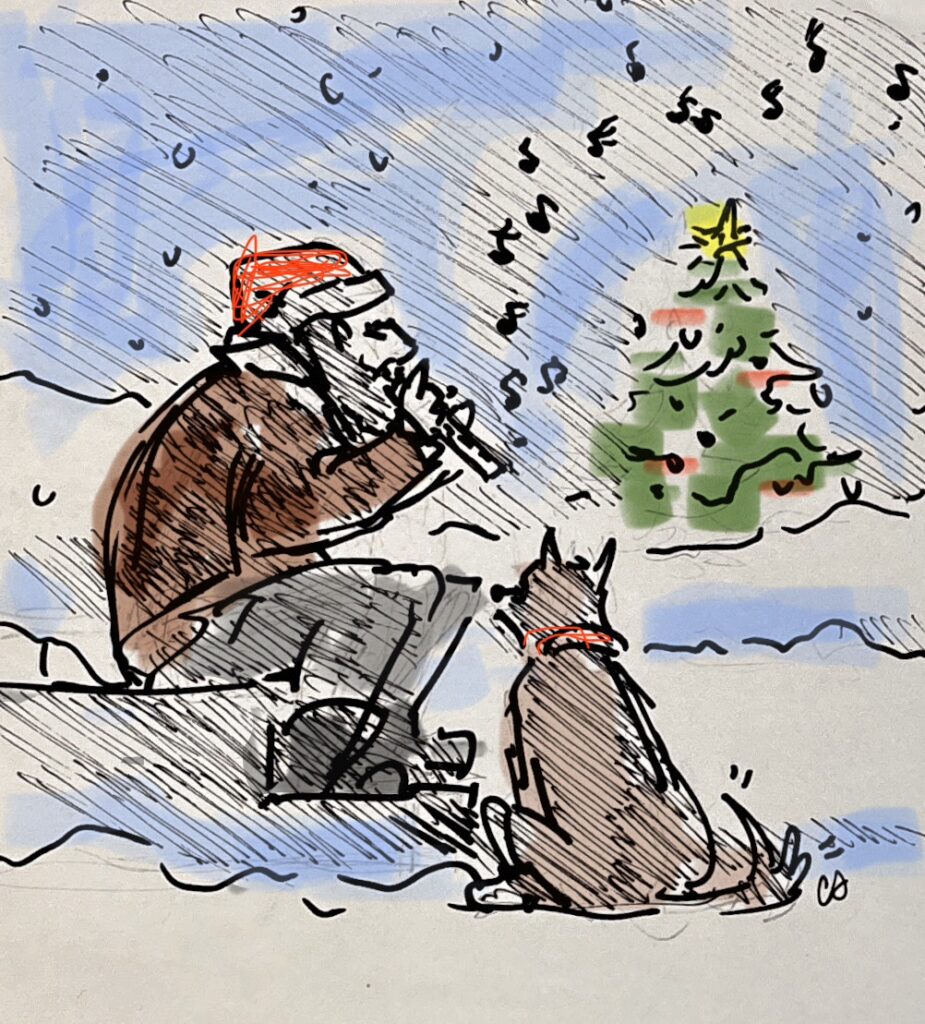 Illustration by Celia Sage.
George Rankel was in a mood. And not the kind you would associate with the season.
Days and nights of snowfall had blanketed the city until the day before Christmas. Only a fool — or a Zamboni driver — would attempt to navigate the narrow downtown core.
But George could not disappoint his mother, though she rarely recognized him anymore. He had promised a Christmas Eve visit. The residence was hosting a special dinner, turkey and roast beef and all the fixings. Ste. Anne’s House was a grand home for residents who had given up one of Toronto’s mansions in Rosedale or Forest Hill. Everything was looked after for the dowagers, including weekly limousine service to Holt Renfrew. A bartender poured drinks in the salon off the foyer in the late afternoons.
Not that Babs Rankel waited for cocktail hour. Like the Queen Mum before her, she liked a shot of gin with her morning orange juice.
George couldn’t care less about Christmas. He hated the hoopla, the false cheer. More than anything, he hated the shopping. Who was he going to shop for anyway? There was no point buying anything for a mother with dementia. Beth and Alexandra, his two married daughters, lived far away and never called except when they wanted something. He had met only one of his three grandchildren. That was years ago, just a few months before Mary had left.
After thirty years of marriage, his wife had decided she didn’t want to spent the rest of her life with a curmudgeon, a bedevilled, lonely man older than his years.
At 64, George Rankel had driven everybody he loved away. Did he care? ‘Not a whit’, he told anyone who would listen. Oh, he had his moments, but he had convinced himself he was better off on his own. As for all the December fuss, he’d be just as happy to see Christmas stricken from the calendar altogether. Let God look after others. George Rankel could take care of himself.
Although his new Mercedes convertible, his one pleasure, was designed for tough conditions, the roads were impassable. With a curb weight over five thousand pounds, the R-500 could do anything except plough the streets. For the first time since he had put Babs in the home two years earlier, George set out to walk the half mile to Ste. Anne’s House. Shouldn’t be more than half an hour down Wellington Street to Front Street and over to Dundas. Best way to get the visit over with.
As he approached the corner of King and Wellington, crowds of shoppers and merrymakers strolled about the promenade. The storefronts were festooned with lights, and the street lamps with garlands of mistletoe and ribbons.
A young girl with burnished, long red hair stood at the entrance of an elegant shop. George had not noticed ‘Le Chocatelier Etrange’ before.
“Merry Christmas!” she said, holding out a tray. “My mother made them.”
She held what looked like a small tree with long stems of vanilla and chocolate truffles for leaves.
George hesitated. Chocolates were a weakness. He examined the tree of sweets and reached out to select a white chocolate ball.
“And make a donation to a friend,” said the girl, motioning to a man sitting behind her on the store’s stoop.
He had an unkempt beard, and, beside him, a large, scruffy brown and white dog that looked like a street mongrel. The dog didn’t stir. The old man looked up at George through glasses that made his eyes distant bottle caps. A toque was pulled down over his ears.
“Please Sir, for the dog,” he implored.
George drew in his flowing coat. “Bait and switch,” he grumbled. “I don’t give to panhandlers.” He swept away, lamenting the privacy of his car.
The visit with Babs was disheartening. She used to be so much fun. He was the youngest, and the favourite of her four children, the one most devoted to her. She didn’t speak a word at the table in the formal dining room. When carollers approached she waved them off. During dinner she looked at her plate as though it were an abstract painting, occasionally poking at the turkey. George didn’t ask for the desert tray.
He was relieved to get away, but a pall settled on him on the walk home. He wondered if he had inherited the Alzheimer’s gene from his mother. What sort of future lay ahead for him?
And the snow continued to fall.
He made his way back down Front to Wellington, where the shopping arcade was almost empty. He wondered about those chocolates. His steps grew quicker, even occasionally slipping off the sidewalk. The girl with the truffles might still be there. Worth a donation to that scruffball this time, maybe.
George felt for change in his pocket as he approached the chocolate store, but it was closed. Only the man with the dirty beard and his mangy dog were there, huddled on a strip of cardboard.
George could hardly bring himself to speak.
“Where’s the girl? the truffle tree? The chocolates?”
The old man looked up through frosted lenses.
“They are all gone, and now I have a collection for Jazz.”
His polite manners caught George off guard. There was a trace of an accent.
“Then why are you still here?” George asked.
“Sir, the shelter is not open yet. Lila has gone off to buy dog food and her mother, Erika, is at the shelter working on tomorrow’s Christmas dinner.”
He spoke English, but with the deliberate phrasing of a European.
“You’d be better feeding yourself rather than that mutt,” said George smugly.
“Sir, Jazz is no mutt. She is Swiss Brown. We have been together for ten years.”
“You’ve been living on the streets for ten years?”
“Oh no, Sir, we’ve been at the shelter for just over a year. Before that I was at Bracklyn.”
“Bracklyn? The home for crazies?”
“Yes, Sir, I was diagnosed with schizophrenia as a young man.”
“What’s your name?”
“Everyone calls me Gene, but my real name is Eugenio.”
“Where are you from, Gene?”
“I was born in Goldap, a small Polish town near the Russian border. My father was killed in the war. My mother brought me to Montreal in 1946.”
“Well, Gene, if I were you, I’d move on. It’s cold, and the streets can be a dangerous place for someone like you.”
When George reached home, he did an unusual thing for a man of his fixed habits. For the first time in months, he went to the living room, which overlooked the park, and sat in the flowered wing chair there. He slumped, in trance of silence, fighting depression and still thinking about that white truffle ball. In the distance a horse drawn sleigh pulled children down a lane of towering blue spruce trees. He could hear the faint jingle of bells. George drifted back to his mother’s dementia and wondered if one day he too would become imprisoned in a world of his own.
Christmas Day arrived in a new blanket of snow. George awoke feeling the onset of a migraine. He had nothing to do. No calls of Christmas wishes to make. No cheery messages to receive. No family to visit. No invitations from neighbours. He shaved and dressed, thinking of getting into his Benz and heading to the coast.
Cape Traverse Farms was George’s main interest these days. 232 acres on the water just outside Waupoos. Waupoos, a Mohawk word meaning wild rabbit, was deep in Lake Ontario, which made it a superior growing zone. There, George was known as a recluse who kept exotic orchards of apricots, pears and plums. Everyone kept their distance. He didn’t take well to anyone coming down his half mile driveway.
George decided to walk to the shops to find Gene. He was curious. Something in his green eyes had caught his attention.
It was early, and the streets were deserted, filled only with snow. A record 43 inches had fallen since the onset of the winter solstice. He retraced his route to the shopping district. At the chocolate store, there was no Gene or Jazz. He decided to head to the shelter a couple of blocks away.
As he approached, voices and music streamed out of the entrance. It was in a huge converted factory, and his coat caught on an iron hinge in the massive front doors as he made his way in. Already he felt uncomfortable with the goodwill filling the shelter. The main room was now a giant banquet hall lined with long, refectory tables laid out for a Christmas lunch. Dozens of volunteers ferried trays to the tables, shouting out well wishes to the several hundred street people crowding around heaping platters of turkey and ham.
At the front of the hall on a makeshift stage, a boys’ choir was singing “What Child Is This.” George started to walk through the tables, asking anyone who caught his attention if they knew someone called Gene, but no one responded. He felt more and more disoriented. At one point he thought he saw Lila and Erika coming out of the kitchen bearing trays of cranberry sauce.
The choir was now filing down the steps, spreading out among the diners, singing the chorus from “Jerusalem.” The crescendo was greeted by whistling and foot stomping. Then the hall fell quiet. The only sound was of cutlery striking plates. George made his way back to the entrance. It was a silly idea to try to track down Gene on Christmas Day. He’d be better off at home with a fire, poring over his manuals on soft fruit trees. He pulled in his sleeves to avoid the iron hinges on the way out when a sound, a distant sweet melody, made him stop.
At the far end of the room, a solitary man swayed back and forth. The music came from a wind instrument. You could hear your own breath in the cavernous space as the man played a haunting rendition of “Silent Night.” The notes soared off the arched ceiling. When the musician turned to play to the other side, George thought he recognized the stooped posture. When the carol was finished, the room broke into wild applause. The man gave a small bow.
The toque and thin blue overcoat. Gene! He rushed through the revellers, carelessly knocking down chairs on his way. But he had disappeared.
The winter storm moved east overnight, bringing open skies for Boxing Day. The mountains of fresh snow reflecting the morning sunshine seemed like a magical kingdom—to everyone except George. By mid-day he was so bored he decided to take a walk to see how quickly the snow was being cleared. He trudged the several blocks to Queen Street and turned onto the shopping promenade
Keeping his head down and arms tight to his side, as he spun around the corner, he walked right into Gene. After righting themselves, Gene broke out, “They stole Jazz last night. I left her outside the shelter and when I came out she was gone.”
“Why would anyone take your dog?”
“It’s a gang that tried to steal my collection once. It’s their revenge.”
“Have you been to the Humane Society?”
“No Sir; I don’t know where they are.”
George grabbed Gene’s arm and started to pull him along. “Come with me. It’s on my way out of town. The far end of Dundas Street.
“Was that you playing the recorder last night at the Christmas dinner?”
“Yes, Sir, but it isn’t a recorder. It’s a reed flute, made of bamboo.”
“You captivated the entire hall.”
“That’s kind of you to say, Sir.”
George’s took Gene straight to his garage. “Get in the car, Gene,” he barked. “We are going on a mission.”
Twenty minutes later, the Mercedes pulled up to the Humane Society. There was no sign of activity and no response at any of the doors, but a great din greeted their knocks on the windows. The back of the building held about a dozen cages. They could just make out a shaggy brown and white dog.
“There’s Jazz,” cried Gene.
The rear entrance was secured with a heavy padlock.
“Gene, how are you at breaking padlocks?”
“We don’t have to. I can unscrew the hinges. The door has been installed with the hinges inside out.”
Gene quickly removed the screws on the hinges and lifted the steel door out of its frame. A howl went up as they stepped inside. The rear entrance led directly to the holding pens. Gene opened a gate and Jazz leapt out.
“Get him in the back of the car,” George ordered.
“But what about the others? We can’t leave them here,” said Gene.
Three other dogs nosed at the steel pen. The smallest was a basset hound, another a cross between a border collie and a Labrador, and the third looked like a pointer mix.
“Open the cage and get all the dogs in the back seat.”
There was no time to think rationally. George was operating on instinct and adrenalin. Gene shepherded the dogs to their new quarters in the Mercedes, and replaced the rear door of the shelter.
Gene reached over from the front seat to calm the four passengers in the back. Jazz was determined to join Gene in the front.
“Where to now, Sir?”
The sun was bright, and for the first time in years, George felt a lightness in his heart. He drummed his fingers on the polished walnut burl trim of his beloved car.
“Feel like taking a drive to the coast, Eugenio?”
The five liter engine surged forward as George accelerated.
“Tell me Gene, how did you learn to play so beautifully?”
“My grandfather gave me a bone whistle flute as a young boy in Poland. I used to play in a small ensemble before I became sick.”
Gene reached into the rumpled case sitting at his feet. He wiped the reed flute clean and started playing “Waltz Number 16.” All the dogs and the driver went quiet. The car flew along the road, out in the open country. Next was the majestic “Chariots of Fire.”
“I’ve got it,” George blurted out. “We’ll call the other dogs Mozart, Schubert and Vangelis. We just have to figure out who’s who.”
“That’s easy,“ Gene laughed, punching George on the shoulder. “Mozart loved a basset horn. The rest we figure out on the way.”
See it in the newspaper