Canada’s oldest weekly newspaper
© 2026 The Picton Gazette
Since 1830


 16° Mainly Clear
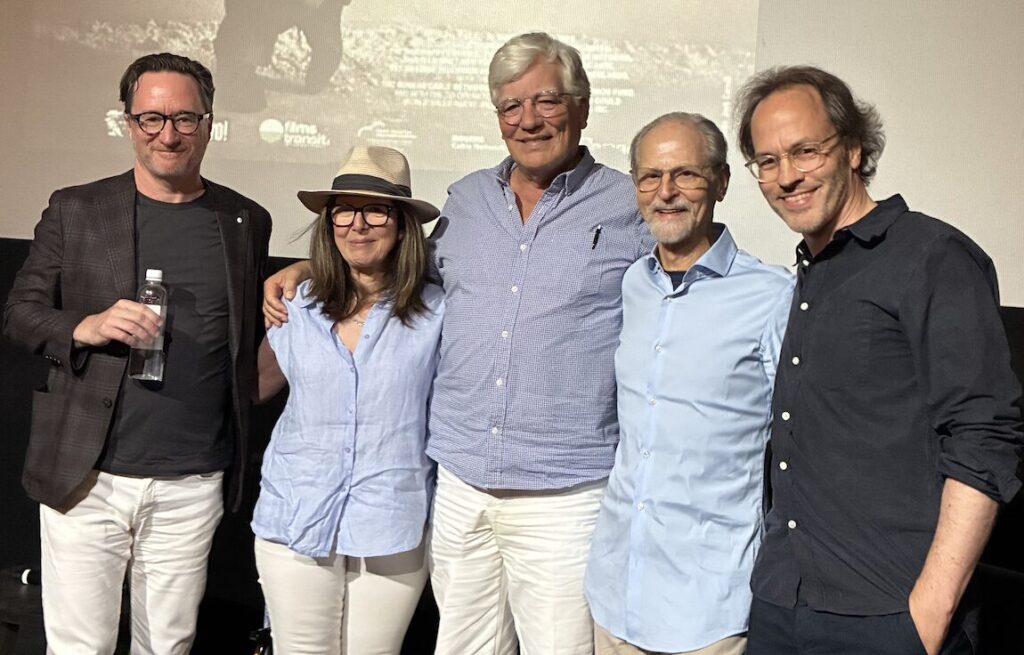 Scott Montgomery, Michèle Hozer, Peter Raymont, Eddie Kramer and Johannes Debus
discuss Glenn Gould onstage at The Regent. (Chris Fanning/Gazette Staff)
Scott Montgomery, Michèle Hozer, Peter Raymont, Eddie Kramer and Johannes Debus
discuss Glenn Gould onstage at The Regent. (Chris Fanning/Gazette Staff)
Glenn Gould came to sudden fame at age 23 with his 1955 recording of Bach’s Goldberg Variations. Amidst the swirl of public attention and international performances, including a tour of Soviet Russia, a very private human being would, in less than a decade, refuse to perform before an audience.
County filmmaker Michèle Hozer and producer-director Peter Raymont, makers of the 2009 documentary, Genius Within: The Inner Life of Glenn Gould, were at The Regent last week, alongside legendary recording producer and engineer Eddie Kramer and BIGLAKE co-founder and Music Director of the Canadian Opera Company, Johannes Debus, for a screening and discussion about the enigmatic Canadian classical pianist moderated by Scott Montgomery.
Gould retreated to a multi-media recording career for the rest of a life that was cut short at age 50. His final work was a new—and radically changed—reading of the Goldbergs.
Like the contrapuntal music of Bach, the film presents a set of juxtapositions, formal and biographical, to imply an inner life in the man behind the myth. The opening sequence, orchestrated by Ms. Hozer, juxtaposes an autumnal Ontario landscape of lakes and golden trees with the sudden stark black-and-white of New York City in 1955, where Gould was recording.
The soundtrack plays Gould’s performance of Beethoven’s Pastoral Symphony. The juxtaposition of this deeply European idea of the agricultural countryside, inherited from classical literature, with an aerial survey of the gentle, yet uncultivated new world is striking, as is the blend into video of Gould performing the piece on a concert stage—only to have the camera move around the piano to reveal an empty Massey Hall.
The piece is, of course, not Beethoven’s fully orchestrated symphony, but rather Franz Liszt’s piano transcription. The distance from the original is characteristic of Gould, whose public appearance, with its easily caricatured eccentricities—the hat, scarf, long wool coat and gloves, even in summertime—became an identity: “who is he when he’s at home?” the documentary asks.
Later in the film another clip from the Massey Hall session reveals Gould staging the motion of the camera note by note, a completely controlled presentation, or, better, orchestration. This is the Gould we hear declaring how much he loathes an audience, and who moved toward meticulously scripted “interviews” and highly edited recordings.
Scenes of Gould in the recording studio show him instructing his recording engineer to cut the tapes, sometimes one bar at a time, to create exactly the product he wants to hear.
Most of these scenes and the habits they reveal are well known. Genius Within’s new angle listens to accounts from those who worked closely with Gould, including, especially, those from women with whom he was romantically involved.
Special to this film is its interview with Cornelia Foss, whose four-year relationship with Gould led to his most intense withdrawal into hypochondriac paranoia and need for total control over all aspects of his life, both personal and artistic.
“He knew what he was doing,” says one interviewee, describing Gould’s life itself as a performance. Was he capable of love? Absolutely, say the women who knew him, but at the same time, there is an overriding sense that he found “domestic life incompatible with art.”
This was an artist who could declare to a living composer’s face, “you don’t understand your own piece!”
Gould’s own self-understanding is explored through the series of selves he presented to the world, or to his acquaintances. As with musical counterpoint, only in the spaces between these notes can we—and perhaps the artist himself—imagine a self. The film imitates this contrapuntal form while keeping up the narrative arc of Gould’s life. It leaves unstated any final answer to the question of an inner life.
In conversation, the panel, too, shied away from “the inner life.” Ms. Hozer suggested that her use of both Gould’s own statements in interviews as well as his music explored Gould’s inner life, and yet, as Peter Raymont noted, even the earliest of the documentary sources were highly staged, and included mounting a camera on the hood of a New York City cab.
Some lyrical scenes of Gould walking the beach or through Central Park are in fact reenactments.
Johannes Debus spoke about how controversial Gould’s interpretations of Bach are, while also suggesting that great art is about “how far you can go as long as you are true to yourself.”
If Bach was different after 1955, this is because of Gould’s power to clarify his structures, metaphysical and physical, into a coherent, logical whole.
Whether or not that testifies to a coherent self is an open question.
Eddie Kramer was a teenager who wanted to be a classical musician when he first heard Gould’s Bach. He was reminded of the profound vision in that first Goldberg recording by what he called the “mind blowing” documentary scenes of Gould in the studio, “holding every bar in his head, and figuring out where every take fit.” He agreed that Gould was a kindred spirit with the other great sonic experimenters of his era, The Beatles.
The afternoon’s screening and conversation pointed to the richness of the PEC arts community, already home to so much talent, and a magnet for more.
This year’s BIGLAKE Festival—a dozen concerts from 21-29 August, is a prime example. Of special note is Ilya Poletaev’s performance of the Goldberg Variations on 23 August, on both harpsichord and modern piano—in itself a contrapuntal exploration.
See it in the newspaper