Canada’s oldest weekly newspaper
© 2026 The Picton Gazette
Since 1830


 16° Mainly Clear
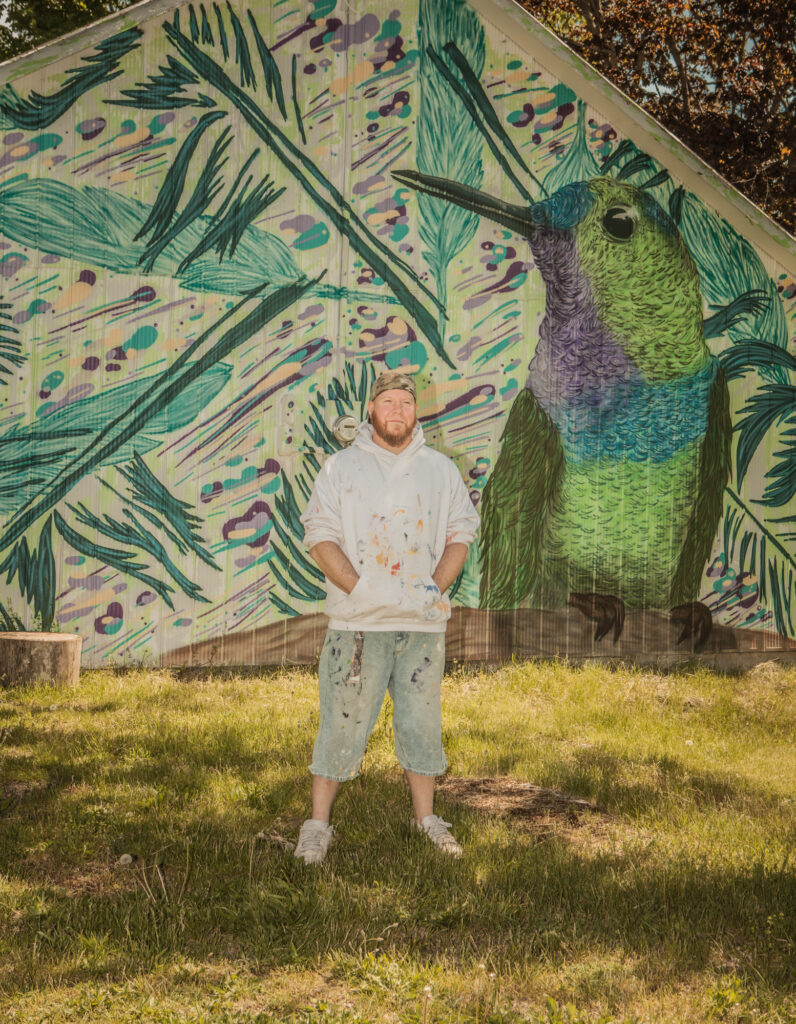 Jamie Janx Johnston and one of his celebrated murals (Photo: Ian Brown)
“The County is begging for a mural festival,” says Francophone artist Jamie Janx Johnston. His statement has cred. He spent years on production at Montreal’s Festival MURAL, the largest in the world.
He points to barn quilts as an important part of the landscape in the County, one to build on. “All the old barns are calling for a last little spark of life before they fall down.”
Johnston’s start, like many young urban artists, was in graffiti. He sprayed his name in order to “leave a trace.”
Blending old and new is one element of Johnston’s interest in layering. He laments the proliferation of “ipad art,” flat, graphic images that now dominate exterior walls, mostly driven by commerce. They don’t centre an artist’s unique stamp, their creative imprint.
Johnston’s stamp is increasingly recognizable: it’s in his use of bright and unusual colours — and the unnerving stare of wild animals. “I’m obnoxious about colour,” he says. His first County mural, of an osprey, still sits on a barn wall in Milford. His restored Morrison Point barn studio is wrapped in joyful animal imagery.
Instead of church, Johnston’s zoologist dad took him into the woods. He not only put a camera in his son’s hand, he taught him how to get animals to look directly at him.
Johnston believes artists fixated on perfection are losing their playfulness. The solution is more public art. “It’s there for everyone everywhere. That’s how art will survive.” The stress on survival is his repsonse to the emergence of AI, which he believes risks undermining the uniquely human outlook of the artist. He believes we’re on the cusp of a necessary new wave of “less safe” forms of creative expression, starting to emerge in a younger, energetic cohort of County artists.
For his part, that means creating bold art from unconventional materials, coordinating teams of artists on joint projects, educating the next generation, and sitting on the County’s public art committee. Art in all its forms sparks intense conversations, ones that allow us to “appreciate art for what it is, not for what it is supposed to be.”
Whether a mural festival takes hold here, or something else, Johnston will be part of it, but behind the camera, not in front of it. His sharp perspectives on the future of art are balanced by the accessibility of his approach.
“I’m just Jamie. I’m just here to hang out.”
See it in the newspaper