Canada’s oldest weekly newspaper
© 2026 The Picton Gazette
Since 1830


 24° Mostly Cloudy
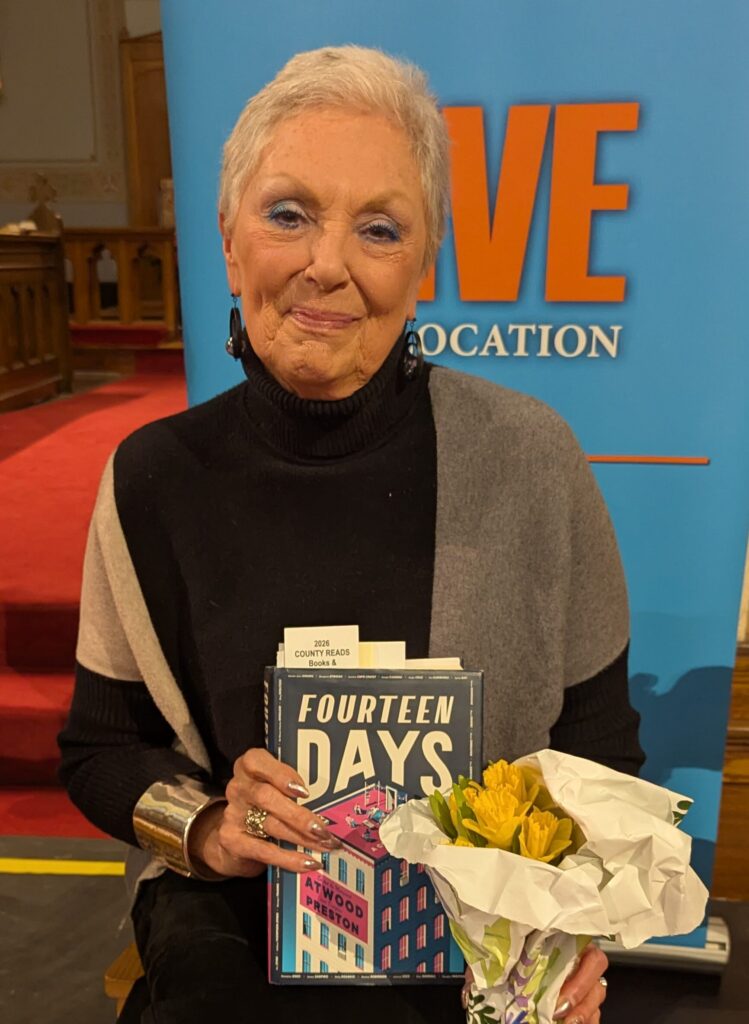 Dorothy Speirs-Vincent with County Reads winning title, Fourteen Days (Photo: Chris Fanning / Gazette Staff)
On what may have been the first official “Fog Day” in living memory, the County Library Authors Festival still raised a great crowd for its much cherished inaugural event, the County Reads Debate.
Five avid readers stand up for the recent Canadian book they feel is the one that ought to be read by all.
For those worried about the enveloping mists on the road, CountyFM broadcast the proceedings live for the first time.
Host and moderator Janet Kellough kept things in order, limiting each speaker strictly to five minutes and reassuring audience members that their votes would be safe, and no storming of the podium would be necessary.
She then introduced the “five stalwart women who have very bravely stepped up to the task.”
Shelagh Hurley defended Margaret Atwood’s memoir, Book of Lives, comically noting that it was tough to sell an author who is already such a well-known quantity. She spoke to Atwood’s “unabashed sharing,” even describing the author’s giggles in the audio recording.
Carlyn Moulton spoke with conviction about Shani Mootoo’s novel Starry Starry Night. “It is not a good book, but a great one,” she argued, a vivid representation of a young girl’s coming of age in 1960s Trinidad. The main character, Anju, she predicts “will become an incantation for empathy and nascent power” for the ages.
Penny Morris represented Doug Griffiths’ 13 Ways to Kill Your Community as essential reading for everyone, bringing to life the kinds of characters who make or break the future of a community. “He gives real examples of how real communities have sabotaged their futures and how others have been wildly successful.”
Judy Kent chose Omar El Akkad’s What Strange Paradise, a fictional representation of the experience of an unwanted nine-year-old immigrant. “I’m sad about the world,” she said. “This book was published in 2021, and in 2026 the immigration crisis is only worse. This book takes us back to some of the humanity that I think we’ve lost.”
The generic range — memoir, activism, and fiction — reflected the diversity of the field, and, in the end, the voting audience went for diversity in a single book, Dorothy Speirs-Vincent’s choice, Fourteen Days, a multi-authored novel edited by Margaret Atwood and Douglas Preston.
It tells a story from the early Covid pandemic, when the residents of a single Lower East Side building in New York come to know each other by force of necessity. Each section is written by a different author, thirty-six in all. Ms. Speirs-Vincent, a literature professor, likened it to Boccaccio’s fourteenth-century Decameron, praising the way in which the cloistered tenants create a “free-form salon,” featuring story after story, “some funny, some touching, some scary, but all a testament to the power of storytelling and its power to unite the community.
“Through stories,” she concluded, “we try to make sense of our world and to bring order to it. Our stories define who we are—and isn’t that why we’re here tonight?”
What community of readers could resist such a question?
The library and its organizing committee are to be praised for yet another successful inaugural start to its Author’s Festival. Watch these pages and online for our visits to other events.
See it in the newspaper