Canada’s oldest weekly newspaper
© 2026 The Picton Gazette
Since 1830


 13° Clear
 Editorial
In January 2018, Ben Doornekamp wrote a letter to the MNR requesting an exemption from the ARA, the Aggregate Resources Act, which regulates rock quarrying in Ontario.
In that letter, released by the MNR in response to a Freedom of Information request, he claimed the areas he wished to excavate were in lands with MX1 and M2 zoning.
But that wasn’t true. The lands were zoned MX and RU1 and had been since 2006. The County’s 2006 Comprehensive Zoning Bylaw zoned the eastern portion of the Picton Terminals property RU1, or Rural. It is called the Sophiasburgh portion because it sits in Sophiasburgh rather than Hallowell. The designation does not allow for a port, materials storage, or quarrying.
Yet that was what Mr. Doornekamp was already doing.
In the same letter, he explains he has started excavating the Sophiasburgh portion, which he claimed, falsely, had M2 zoning, because, he says, no permit is required for site grading in PEC. And further, he sensed “good feelings” at the Ministry of the Environment about his plans to construct dry salt storage containers there.
By beginning excavations in Sophiasburgh, where permits are not required, he explains, he will “drastically shorten construction time.”
Just by the by, those containers would not be completed until 2025, seven years of quarrying later.
In January 2018, however, Mr. Doornekamp was well acquainted with the RU zoning of the Sophiasburgh lands.
He had hired Fotenn Planners to prepare an application to the County for a zoning bylaw amendment to consolidate the entire property, including the Sophiasburgh portion, into a proposed MX-7 zone. That was in 2016.
In that application, planner Michael Keene notes, genially, “the current use of the site is unchanged from its historical use as an international import/export shipping port service facility.”
But this was not true either. The “current use of the site” was rock quarrying.
A flurry of 2015 emails, also obtained through a Freedom of Information request, show Ben Doornekamp urgently seeking assurances from the MNR on a series of “deals” for supplying aggregate to the 407 extension project and Amherst Island wind farm.
In November, 2015, Mr. Doornekamp wrote, “we want to be very sure nothing has changed because we are very close on deals for the 407 extension and the Amherst Island windfarm granular supply.”
These deals rest, he says, “on the merit of previous emails from Steve.” The reference is to the MNR’s Steve Kilby.
“We want to do our due diligence again before we finalize these deals. We want to be 100% sure once these deals happen.”
But Steve had gone missing. Instead, Christian Verschuren, an Aggregate Technical Specialist at MNR, was objecting: the zoning did not allow for receiving or storing bulk goods, including aggregate. “Ben, it is fairly simple for me,” he wrote, also in November 2015. “As previously stated, your site plan does not provide for the importation of any type of material, Table 1 material included. So from MNRF’s perspective, any materials imported to the site must be removed. Looking forward to some finality on this issue.”
Things seemed a little more friendly by April 2016, when Ben wrote to Mr. Verschuren, “Chris, I was thinking it would be a good idea to have the letter on file as discussed during your site visit to the effect PT is permitted to process and sell surplus rock from our site.”
But, again, Mr. Verschuren responds with a request for documentation. Before he can get official, he writes, he needs confirmation of the municipal zoning, and an approved development plan for the site.
After that the correspondence breaks off. Ben Doornekamp hired Fotenn, to try to get the right zoning for what he wanted to do: quarry, process, and sell surplus aggregate.
In that 2016 Fotenn application for a Zoning Bylaw Amendment, after noting the Terminals has always been a shipping port, Mr. Keene further points out that the 2006 Comprehensive Zoning Bylaw, in zoning Picton Terminals lands MX and RU1, had made a mistake, and “failed to include the easternmost portion of the property.”
He meant the Sophiasburgh portion. Pre-2006 it had been majority zoned for Agricultural (A1). A smaller piece on the shore was zoned M2.
But all of it, as we know, was now zoned RU1.
While suggesting that the proposed by-law amendment would simply “restore the historic zoning that would permit the shipping port operation,” what Mr. Keene was really asking for was to extend MX-Industrial zoning across the Rural portion of the site to allow for quarrying, ore storage, and aggregate processing there as well.
All the activities, in other words, in which Mr. Doornekamp was already engaged.
We know this because then, as now, concerned residents were interfering in Ben Doornekamp’s plans as best they could. In 2017, Save Picton Bay initiated a court case to clarify the zoning of the property.
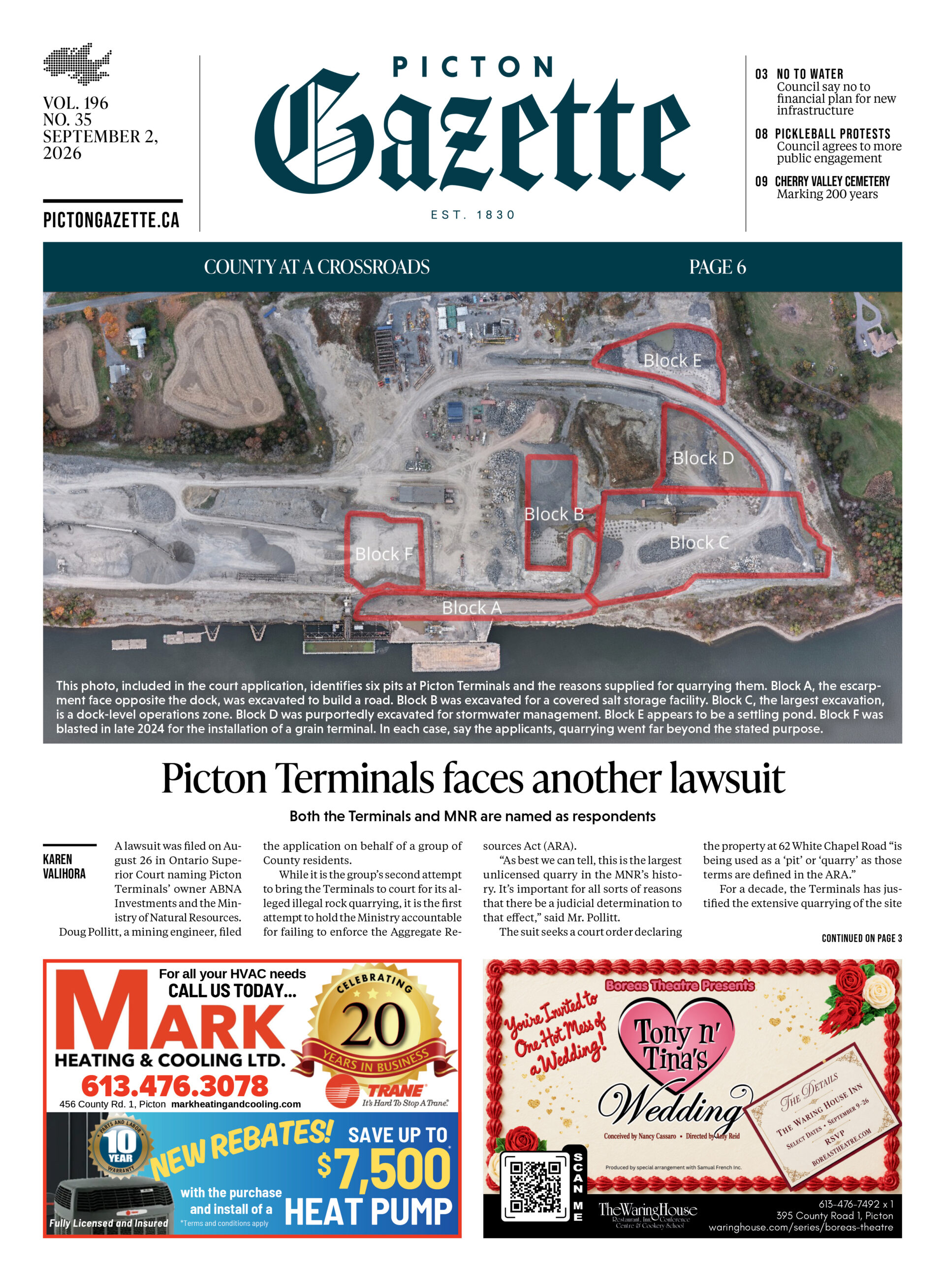
In court, Save Picton Bay testified that the Doornekamps were constructing berms, undertaking site grading and landscaping activities, and excavating pits on the Sophiasburgh portion of the site, all contrary to the RU1 Zone Bylaw. They noted the activity required a licence under the ARA, and no such licence had been sought.
Our Fotenn planner, Michael Keene, submitted an affidavit to the court claiming the only thing happening on the Sophiasburgh portion was “landscaping,” for which, obviously, no licence was required, and constructing storm water management ponds, pursuant to an order of the Ministry of the Environment, to address the ongoing issue of runoff from salt stored improperly at the site.
Judge Tausendfreund took the affidavit at face value, noting that storm water ponds are permitted in any zone in PEC.
Storm water ponds in Prince Edward County can be at most three metres deep. While the stormwater ponds on the Sophiasburgh portion are, technically, three metres deep, they begin at 22m underground, at the bottom of the gigantic excavations across the Sophiasburgh portion.
Meanwhile, the salt storage structures Ben Doornekamp claimed he was building there are 23 metres deep, and they are not on the Sophiasburgh portion, but next to it.
But I am getting ahead of myself.
In the 2018 Save Picton Bay case, Judge Tausenfreund issued a split decision on the zoning: all activities associated with operating a port would be permitted as a legally non-conforming use of the site, no matter the current zoning. But not on the Sophiasburgh portion. The only thing allowed there as a legal nonconforming use would be occasional vehicle storage. Stockpiling aggregate material was not permitted. Quarrying, likewise, not allowed. A port, also, not allowed.
The decision was a disaster for Ben Doornekamp. He was already quarrying the Sophiasburgh portion. He had already engaged in major contracts to supply aggregate to the 407 Extension and the Amherst Island Wind Farm — among others. What to do?
Here is where things get murky. According to the MNR, nothing untoward happened then, and nothing untoward is happening now. It no longer seems to employ an aggregate technical specialist who cares about zoning, development plans, or site plans.
But according to the County residents about to launch yet another court case, that’s all wrong. The zoning does not permit any quarrying at all, and the excuse about dry salt storage containers is just that, an excuse for quarrying and selling massive amounts of rock with no licence. Infrastructure works, they note, are not a sufficient reason for exemption from the ARA. Nor are lies about the zoning.
See it in the newspaper