Canada’s oldest weekly newspaper
© 2026 The Picton Gazette
Since 1830

 19° Mostly Cloudy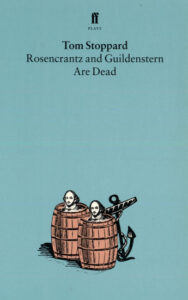
Rosencrantz and Guildenstern, two minor characters from Hamlet, have very little to do on the outskirts of perhaps the most famous play of all time.
What happens when Tom Stoppard comes across them? Imagine Waiting for Godot somewhere in a Shakespearean Denmark.
He does not give these two bit players a rich alternative life. No, they are simply waiting in the wings.
What happens while the grand tragedy is developing elsewhere—on the main stage? Not much. A coin toss. Literally. The first five words of Rosencrantz and Guildenstern are Dead are, “Heads … Heads … Heads … Heads … Heads.”
What are the chances?
With this sly bit of fun, Stoppard launches us into a reflection on art and existence. Rosencrantz and Guildenstern are not the sharpest knives in the box. They are not Hamlet, nor Horatio, nor even Laertes or Polonius. But, somehow, they know they’re in a box of bit parts.
The brilliance of Stoppard’s break-out play—it is 60 years old this summer—is to bring the paradoxes of philosophy into a slapstick comedy. As with Samuel Beckett before him, there is a strong vein of the Marx Brothers here. For the reader of play, the deadpan stage directions are a comic delight.
Due to copyright restrictions on the film, the screening is only open to BoF Club members.
But a single event pass covers both the film and a wine-and-cheese laden discussion a couple of weeks later.
Shakespeare’s Hamlet famously contains a play within the play: an itinerant theatre troupe comes to perform at the court. Hamlet calls their production “The Mouse-Trap,” as he intends to use the performance to expose his evil uncle Claudius, who has usurped the throne of Denmark.
Stoppard steps into this paradoxical tradition by writing a “play without the play” of Hamlet. He asks, what happens to characters when they’re not on the stage? Who are they? What do they do? Do they even exist? At a crucial moment halfway through, there’s a reflection upon the meaning of being an actor: “You don’t understand the humiliation of it—to be tricked out of the single assumption which makes our existence viable—that somebody is watching…”
Throughout Stoppard’s play nobody—not even Rosencrantz and Guildenstern themselves—is quite sure which is which, or who is who. Although the famous line in Hamlet comes in the very last scene, it becomes apparent (to us and, perhaps, to the characters themselves) that Rosencrantz and Guildenstern Are Always Already Dead.
Yet Stoppard somehow makes them as immortal as Estragon and Vladimir, Sancho and Don Quixote, or Ernie and Bert.
That it is Hamlet, a play with which we cannot be unfamiliar, taking place offstage and yet governing the action we watch, makes us, also, pawns in the game.
In his 1990 film of the play, which features bravura performances by Richard Dreyfus as the Player, whose English accent creaks like the boards of his stage, Gary Oldman as a whimsical Rosencrantz, and Tim Roth as the frustrated Guildenstern (I think!), Stoppard foregrounds the itinerant players. A running gag features Rosencrantz unwittingly reenacting key moments in the history of modern physics.
A collaboration between The Regent and the Gazette, the fourth season of the Books on Film club pays tribute to the late Tom Stoppard. A private screening of the film on March 30th is followed by an evening of conversation on April 15th. For tickets for these evenings or the entire series click here.
See it in the newspaper