Canada’s oldest weekly newspaper
© 2026 The Picton Gazette
Since 1830


 24° Mostly Cloudy
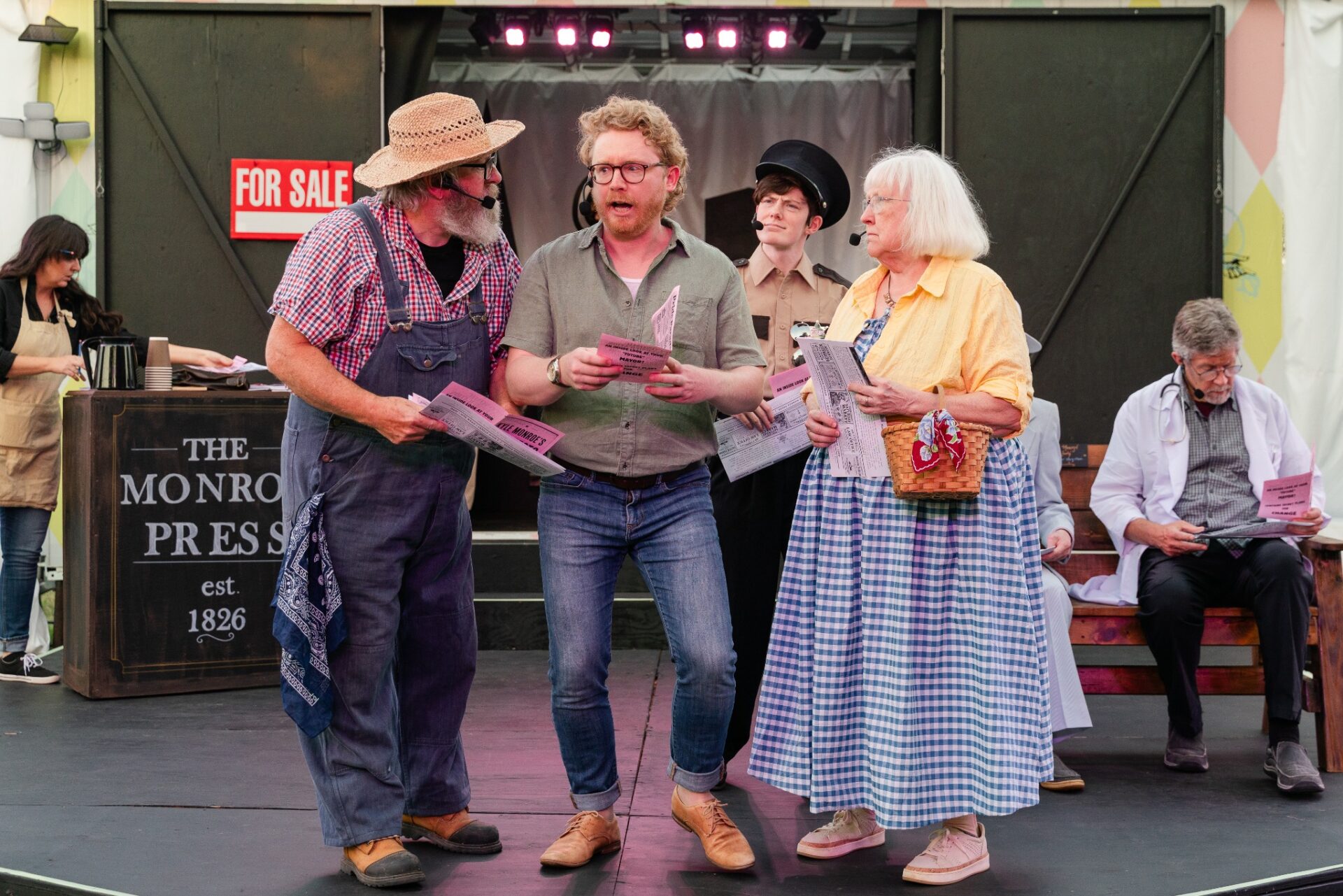 Small Town centers on The Monroe Press, established 1826. (Photo by Sarah Kirby)
Small Town, produced by Theatre Roulant outdoors at the Waring House, is a delight, and not just because it’s centred on The Monroe Press, founded in 1826.
It must be said, though, that a series of scenes take place in and around the town paper, which everybody reads all the time, of course, and whose office doubles, magically, as a coffee shop, trading chiefly in the latest rumours.
Literally, these are written down and handed in to the editor, which made me laugh, like a lot of the other jokes here. I wasn’t alone. The night I attened, a packed audience of about 50 broke into laughter and animated conversation throughout the play.
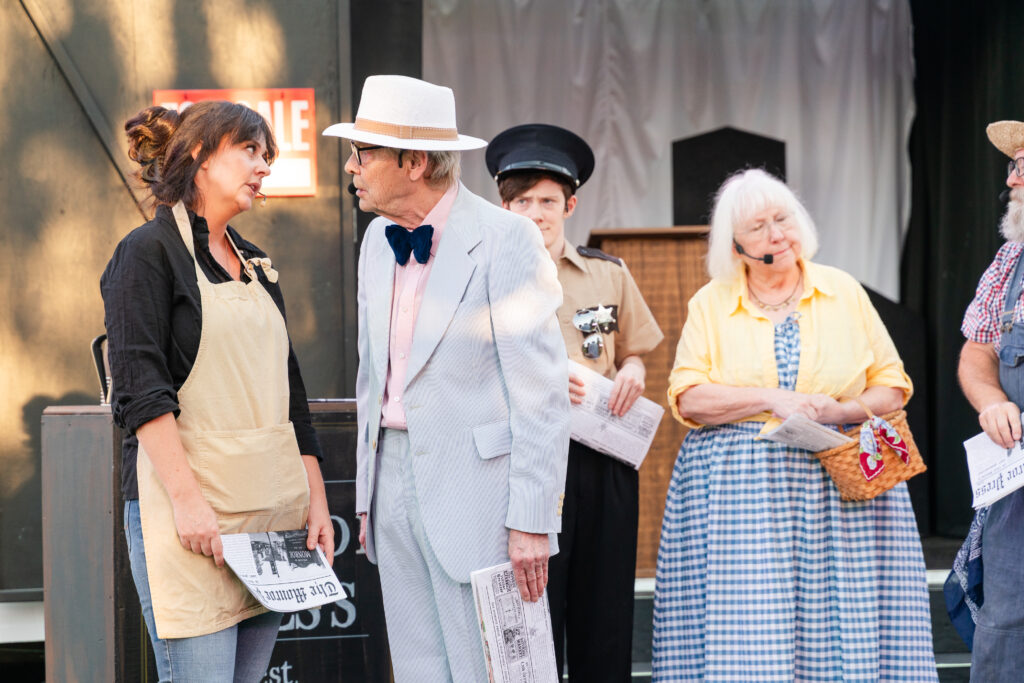
Small Town tells the story of Kate Wright (Megan Hutton), the newspaper’s publisher, and Kyle Monroe (Aaron Armstrong), who wants to run for Mayor, which would mean displacing his grandfather, Lyle (Bill McMahon). The Wrights and the Monroes are the oldest families in town; the Wrights have always run the paper; the Monroes have always supplied the mayor.
Both Kyle and Kate are at the end of the line, both literally and figuratively. Kyle’s partner, Jonathan, who is also Kate’s brother, has died, leaving both characters bereft.
The play opens with Kate putting the historic newspaper up for sale. Like Monroe’s other young people, she wants to seek greener pastures — and abandon her inheritance. “Dying traditions in a dying town are something to embrace,” she says sarcastically. “This is where the culture is agriculture.”
Kyle, meanwhile, aspires to save Monroe from its change-averse death spiral. He has big plans — new development, a tourist economy, and a water treatment plant, to name just a few.
Rumour mill, manifesto, source of coffee shop
discussion and debate — in Megan Hutton’s Small Town,
the local newspaper is a signal source of
community connection — and transformation.
But Cecilia Parish (Amy Reid), the local Christian Lady, considers change a modern version of the plague, and the neighbouring city, Grenville, a source of pollution. She plans to interfere with some desperately needed physician recruitment — the town’s one doctor probably should not be practicing anymore — by making sure any would-be new doctors bring no big ideas with them.

Worried by Kyle’s plans, she nicks his notebook and prints out his ideas on the paper used for the church bulletin. She secretly inserts this “manifesto” into every issue of the latest Monroe Press. Kyle is aghast to find his secret plans and ideas the next day’s newspaper fodder.
Sure enough, his grandfather is soon asking him what exactly a Pride Parade is, while confusing a tourist economy with a terrorist plot.
This is a lively, funny, and yet sharply critical play that explores the power of transformation in a town dead set against it. It also suggests that without the right motives, change is an imposter, the same greedy, judgmental small-mindedness dressed up in fancier clothes.
Ms. Hutton is a rarity: a local writer writing directly about local life. Her The Ultimate County Kid, produced by the Marysburgh Mummers at Mount Tabor this spring, explored what it means to be “true County,” and featured a number of PECI students in its cast. Ethically motivated, that play insists on inclusion: any place worth living in has a place for everyone. Small Town goes further, examining the deep sense of relationship unique to a small town. It suggests true sense of place is created from the inside. It is not external. And if it is disappointing, that, too, offers a source of richness and complexity — if you are willing to work with it.
Some of the transformations the play explores verge on the wildly improbable, like Cecilia Parish’s apology. But Jane Austen herself was never above a little wishful thinking. Others, like Lyle Monroe’s about-face on his grandson’s coming out, feel entirely genuine.
I’m already looking forward to Ms. Hutton’s next County production. A real talent lives among us.
See it in the newspaper