Canada’s oldest weekly newspaper
© 2026 The Picton Gazette
Since 1830


 11° Sunny
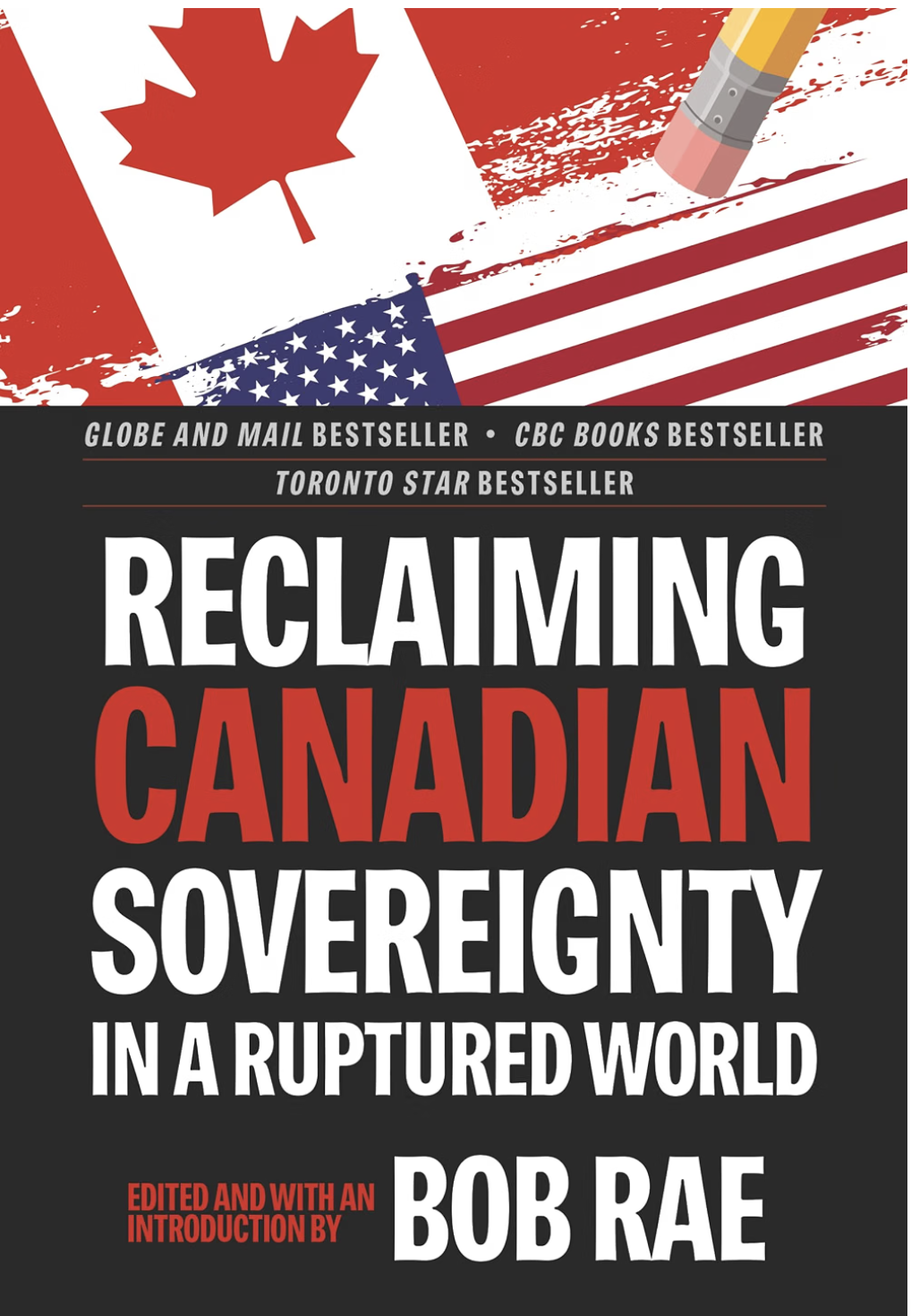 Cover of Bob Rae’s edited collection.
If you relish Netflix’s The Diplomat as much as I do, you will have learned that diplomacy involves a deft, relational, even conversational politics. In the show, the American Ambassador to the UK is on the front lines of a global order under attack from within. She works with an assemblage of splendid talkers to unravel complex international intrigue from her official residence, the palatial Winfield House in London’s Regent’s Park.
It’s nice work if you can get it.
Bob Rae’s new edited collection, Reclaiming Canadian Sovereignty in a Ruptured World, engages precisely the same territory — and invites us to engage with it, too. Formerly Canada’s Ambassador to the United Nations, Mr. Rae has assembled a dream team of splendid talkers in his latest volume — journalists, academics, diplomats, novelists — who offer a series of sharp takes on our moment.
Reading it allows us to enter the rarified world of international diplomacy — on Canadian terms.
The collection is up-to-the-minute. It opens with the January 2025 gangster attack on Ukrainian president Volodymyr Zelensky in the Oval Office, as well as Prime Minister Carney’s February 2026 identification of the rupture of the established and taken-for-granted international order in Davos. These two moments are the collection’s call to arms.
Each essay, by such luminaries as Margaret Atwood and Kathering Govier, is centered on defining and advancing Canada’s best interests. There is not a writer here who does not understand those in terms of the good of the whole, both of Canada itself and the world. That is, the values that inform a collective understanding of what Canada stands for — human rights, Indigenous sovereignty, the rule of law, peacekeeping, foreign aid, leadership in the fight against climate change — are at once taken for granted, and spur Canada’s defense.
Somehow, this defense does not come across as old-fashioned — even if, as Rae points out in his introductory essay, our reputation on the world stage as peacekeepers is a thing of the past, and any leadership on climate change has, at least for now, disappeared.
Rather, this resurgence of historical values suggests the time has come to reclaim what works in the rules-based international order and its signal institutions — NATO, the EU, the Five Eyes — and to revise what does not.
The novel idea that Canada is on the front lines of this revision, a leader in the invention of a new world order, is another spur.
An astonishing number of the essays chart the decline of a rich and well-informed public conversation, the kind this book seeks to create, under decades of both governmental disregard, and the combined assaults of social media, the algorithm, and AI.
Canada’s refusal to regulate the foreign-owned digital platforms
operating within its borders,
and in Meta’s case in defiance of Canadian law,
is repeatedly called out as a signal failure
to protect its sovereignty.
Former CBC journalist Carol Off’s essay “A Brief History of Truthiness,” begins with the 2006 invention of the word on The Colbert Report, and reminds us of Kellyanne Conway’s 2017 “alternative facts.” While Off starts with comedy, however, her essay calls on the Carney government to get serious about regulation. “Security agencies around the world, including Canada’s, now recognize the breakdown in truth as one of the most serious threats to our national defence and to our sovereignty,” she argues.
Likewise, Richard Stursburg, former CEO of Telefilm Canada, Chair of the Canadian Television Fund, and head of the English CBC, offers a lively consideration of the erosion of Canada’s cultural protection laws under Mulroney, Chretien, Harper, and Trudeau in “Cultural Sovereignty: The Challenging Gap.” He charts cuts to the CBC that started with Chretien in the 1990s, alongside the Book Publishing Fund, Telefilm, and the Canada Council. At the same time, he notes, Amazon moved in to kill all bookstores but the odd Indigo, turning the Canadian publishing industry into mere collateral damage.
Stursburg reserves special mention for the Trudeau Government’s “enthrallment” with the big social media platforms. “Trudeau and his ministers went to Silicon Valley to court them. They embraced the Harper government’s refusal to tax the streamers, let alone force them to make commitments to Canadian content….Ex-Google employees became chiefs of staff; Facebook lobbyists were everywhere.”
Google and Meta’s digital advertising monopolies export billions out of the Canadian economy every year, leaving nothing behind for film, for newspapers, and for television. The ascendancy instead of TikTok, Instagram, YouTube, Netflix, and Amazon, he notes, is just another form of colonization.
“A country that cannot independently gather information,
—Lloyd Axworthy
govern data, protect communications,
or interpret events
cannot exercise full sovereignty,
however many flags it flies.”
In “Knowledge Sovereignty in the Age of AI,” Philip N. Howard takes the argument a step further, to consider the degradations wrought by AI. “The issue is not simply that voters may encounter a false claim. It is that the systems through which they encounter political information increasingly obscure where a claim came from, what process produced it, and which institution is accountable for it.”
AI, he notes, operates beneath the surface. “Instead of competing with Canadian journalism, it ingests it. Instead of citing public expertise, it paraphrases and displaces it. Instead of clearly separating foreign influence from domestic debate, it allows narratives to move across borders, platforms, and languages. The result is a continuing erosion of Canadian epistemic sovereignty under more powerful technical conditions.”
In the excellent “Sovereignty and Trumpism,” former diplomat and politician Lloyd Axworthy connects the erosion of cultural and epistemic sovereignty to every other form. “A country that cannot independently gather information, govern data, protect communications, or interpret events cannot exercise full sovereignty, however many flags it flies.” Sovereignty today, he notes, “is less likely to disappear through formal annexation than through the gradual erosion of autonomous political capacity.”
Axworthy pays special attention to the economic fragility exposed by Trump’s tariff regime, and links it to pressure to integrate our defense capacity with American technology, infrastructure, methods, and interests. Today’s threats — Russian imperialism, authoritarianism, cyber conflict, foreign interference, and competition for the Arctic — require a very Canadian kind of careful co-operation. Yet, “the question in 2026 is not whether Canada should co-operate with allies, including the United States, but whether it retains sufficient independent capacity to shape the terms of that co-operation.” He argues, “sovereignty is not being overtly surrendered. It is being operationally absorbed.”
Another standout here is “Making the Carney Doctrine Real,” by Michael Kovrig, the diplomat and intellectual who spent close to three years in a Chinese jail. He stresses the powerful obstacles to Carney’s vision of a consortium of middle powers forging multilateral trade and defence alliances, and offers pragmatic solutions — while chastising the PM for making convenient trade deals with China, like Canola for EVs. “Effective co-ordination can make [economic] coercion costly — but only if enough participants are willing to suffer pain and subordinate their own narrow interests for common goals,” he stresses.
The foreign policy experts call this hard-headed pragmatism “realism” — but even that realism charts a course that keeps the common good front and center. The only way to truly win friends and influence people is to invite them to something worth fighting for. That is what this book does —with aplomb.
Bob Rae will discuss his book in conversation with Bill Roberts at St. Mary Magdalene Church in Picton on Saturday 28 November at 2pm. Tickets available through the Public Library.
See it in the newspaper