Canada’s oldest weekly newspaper
© 2026 The Picton Gazette
Since 1830

 23° Mostly Cloudy
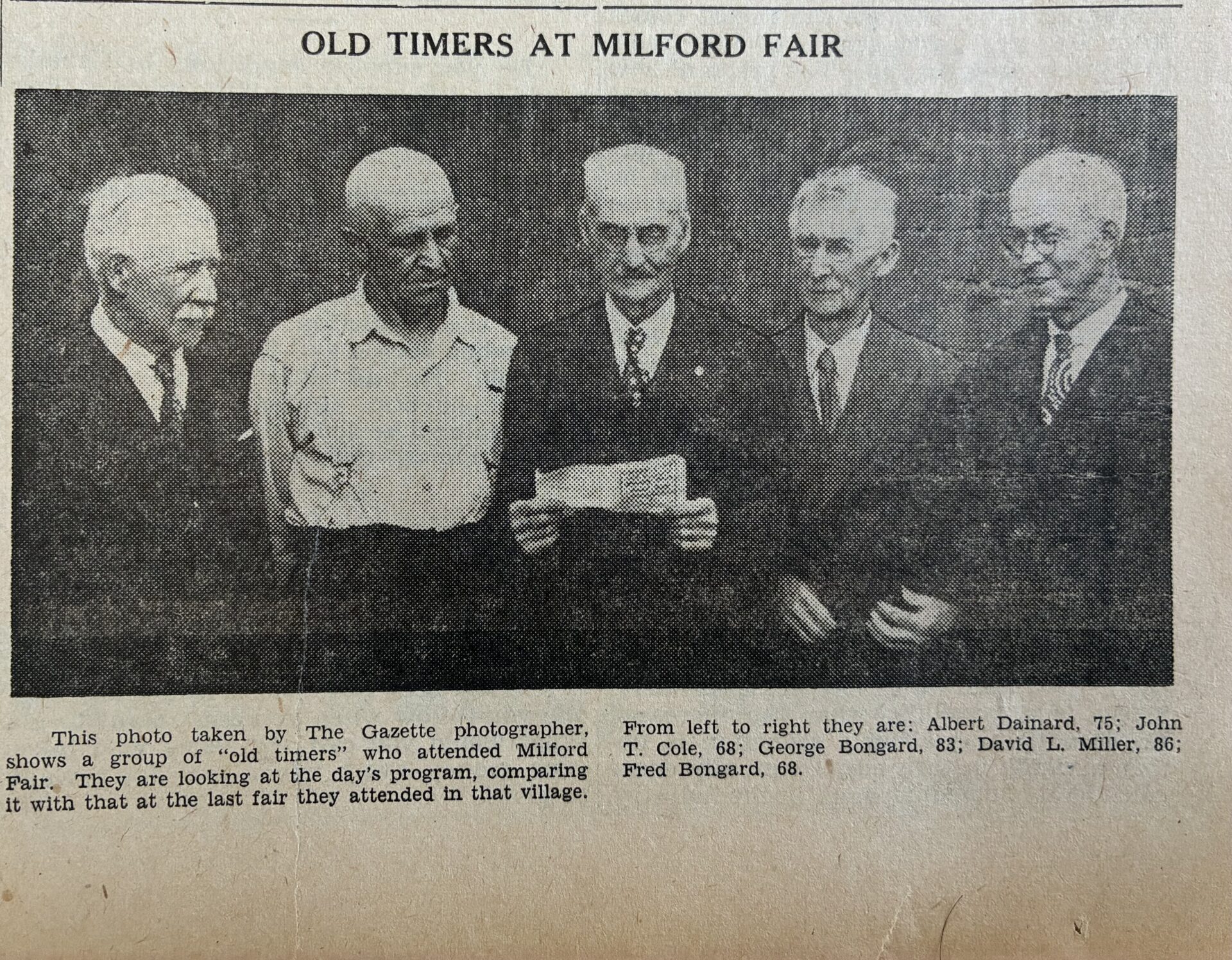 OLD TIMERS AT MILFORD FAIR — Five men who attended the original Milford Fair look over the day’s program at the revived fair in 1946. (GAZETTE ARCHIVE PHOTO)
In August 1946, a small notice appeared in the Gazette: “Big Time Planned For Milford Fair, Sept. 11.” The fair expected “a big array of exhibits by South Marysburgh school pupils.” The prize list was out, and the entertainment and sports events set, including the finals of the mens’ and girls’ softball leagues.
“Milford’s old-time fair is staging a come-back,” it enthused, “and the afternoon of Sept. 11 will doubtless see a huge crowd attend.”
It had been 52 years since the last Milford Fair.
The news reports confirm the success of the day. One article opened with a description of a banner celebrating the previous incarnation of the Fair, which “clearly indicated the romantic past enjoyed by that section of Prince Edward County.”
A group of “old-timers” who had attended the previous Milford Fair 52 years earlier posed for a photograph. “These men recalled former fairs they had attended and which were held at a site back of the present town hall. They were thrilled to see the fair in existence again and had many words of praise for those responsible in reviving the former annual event—last held in 1894.”
Two world wars had taken place since the last fair, and one of the motives for its revival was to honour those who had served with the unveiling of the Township Honor Roll.
The rest of the lengthy report celebrates the Fair’s success. Despite an interval of rain, “the large crowd refused to leave the grounds and good-naturedly huddled in all available shelter until the sun shone again.”
For more details from the 1946 report, see this week’s Living History.
This year marks the modern Milford Fair’s 80th anniversary. Bruce Dowdell, sometimes known as the “Mayor of Milford,” is also the Fair documentarian, and is now participating in his 28th.
The fair has downsized a bit in recent years. Mr. Dowdell fondly recalls the late 1990s. “Back when I started getting involved, it was an all-day event. It started at ten in the morning with the dog and cat show before the Fair even started. And then the parade at 11, and then the fair, which ended at four.
“Then we came down here for the canoe race. Randy York and his brother always won the canoe race. They were, you know, finished and on their way home before we got back. So I suggested to the board that we have two races: the regular one and a geriatric race!
“And then after that, we’d go back to the town hall for, usually, a pork dinner. And then up to the Mount Tabor for a night show, which would go on forever!”
According to Mr. Dowdell, the modern Milford Fair originated in a 1945 picnic for the veterans who had returned so far. And this has always defined its community feel. “You know, I’m out in left field in this, but I look at the Milford Fair today as like a big picnic. When you say a fair, most people think of, you know, a midway and all that kind of stuff. This is a one afternoon get together, where we have games, and we have entertainment, and we have vendors, and the displays, you know, that kind of thing.
“The other thing I always liked about it was that, especially when you had kids, you didn’t have to worry about them. I remember telling my grandkids, ‘Okay, if you can’t find your mom and dad or me, you go to the bandstand there and tell them to page us’. All those kinds of things made it very comfortable.”
Mr. Dowdell was kind enough to put the Gazette in touch with a South Marysburgh resident who attended the first Milford Fair in 1946. On condition of anonymity, she has supplied us with the following account.
I attended Milford Fair in 1946, when I was six years old. At that time, the Milford Fair was held on Wednesday afternoon.
In the 1940s, there were seven one- room public schools in South Marysburgh. The pupils all assembled at the Milford Town Hall to march in the parade.
The parade started at 1 pm with a band leading the Reeve, Councillors and all the school children. Each school had a banner telling everyone what school they were from. Following the children were decorated cars, bikes, members of the Pony Club on horseback, horse drawn wagons, and wagons loaded with farm produce: squash, corn, tomatoes, watermelon, sheaves of grain, stooks of corn stocks, etc. The local United and Anglican churches often entered a float in the parade, each with a specific theme. Another band marched at the end of the parade to the fairgrounds where judging took place.
In the shed were our entries of vegetables and flowers for the competition. We were given seeds to plant in the spring so we could enter the produce and flowers we grew from them in the fair. Our teachers kept our school art work for display. There were tables for baking, sewing and knitting to be judged.
Behind the shed was the Food Booth where we could buy hot dogs, a real treat that we didn’t get at home. There were many kinds of pieces of pie for sale, all made by our mothers. In later years, the 4-H booth provided milk shakes we could buy.
Across the grounds were contests like log sawing and nail and hammer pounding. A great attraction was the year-end 4-H Calf Club competition with entries from North Marysburgh and Athol as well as South Marysburgh.
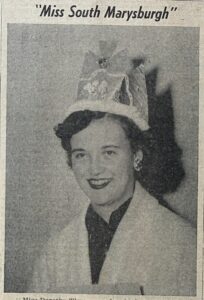
In the late 50’s, a contest was held to name “Miss South Marysburgh.”
This year’s Milford Fair, a fundraiser for community causes, runs Saturday, September 19th at the Mount Tabor grounds. Visit milfordfallfair.com for more information.
See it in the newspaper