Canada’s oldest weekly newspaper
© 2026 The Picton Gazette
Since 1830


 11° Sunny
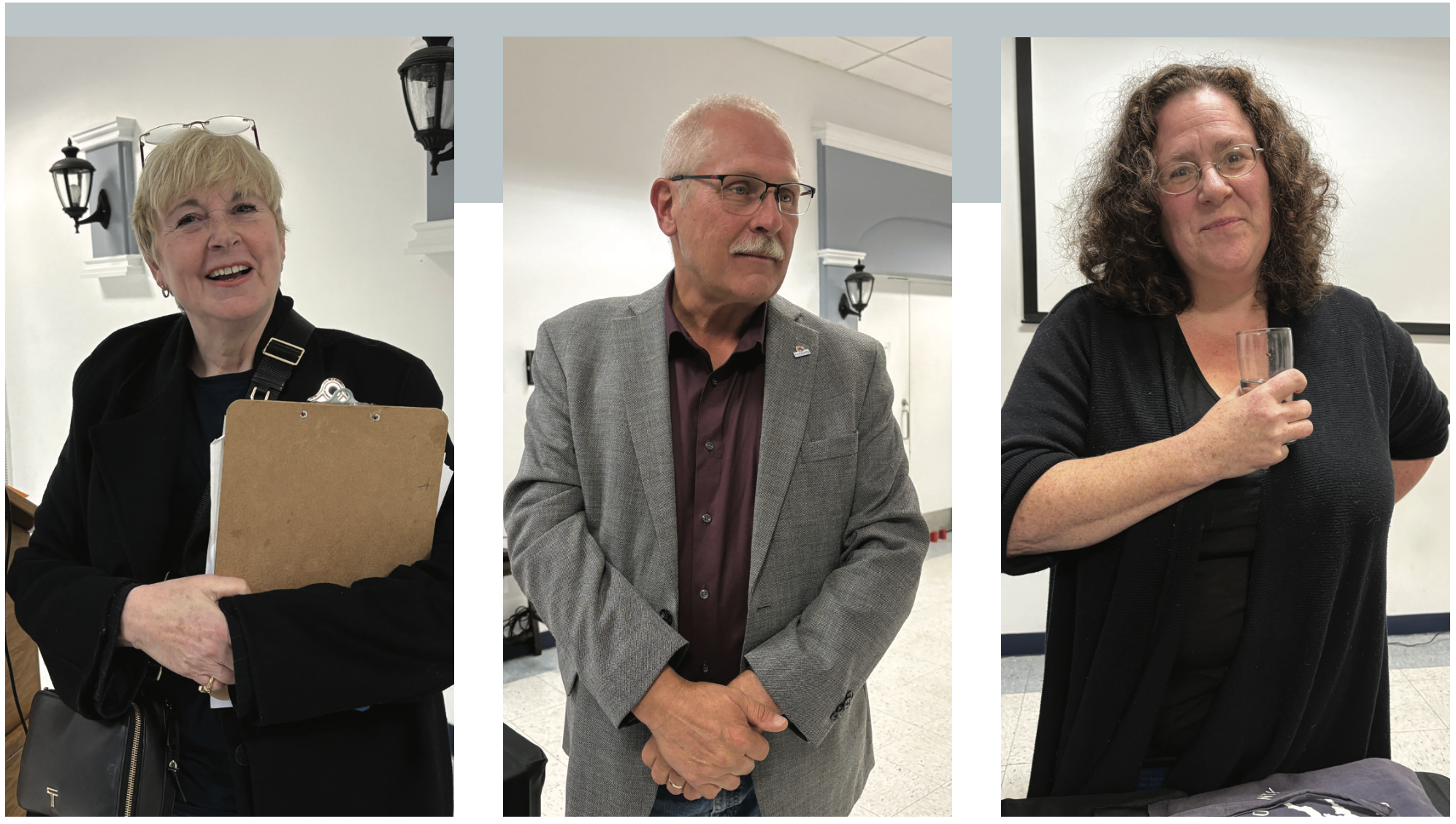 Jane Lesslie, Phil St-Jean and Kate MacNaughton (Karen Valihora/Gazette Staff)
The Picton BIA convened a lively town hall for the three candidates vying for two seats in Picton last week. A fourth candidate, Emery Niles, was unable to attend.
Camaraderie and a sense of shared purpose around the need for affordable housing, growth, and reliable water infrastructure in Picton united incumbents Phil St-Jean and Kate MacNaughton, while Jane Lesslie stressed a future that demands caution.
Ms. Lesslie, who has extensive experience in banking and fund management, opened the proceedings with a series of priorities: a financial path to ensure the long term affordability of any new water infrastructure; environmental protections and a complete climate risk assessment to unlock green municipal funds; full time jobs and stronger year-round business cycles; and improving childcare for young families. She also stressed restraint.
“We’re facing a really tough few years. Every dollar has to have an impact.
“Our new Director of Finance, Aaryn McNichol, is really excellent and interested in improving efficiencies, particularly using technology to get more done with less.” She would like to see a staff hiring freeze, and more use of AI at Shire Hall as one way of “using tech to do more with what we have.”
Ms. MacNaughton opened with a reflection on her eight years on council. She has learned much about “the sense of inclusivity, empathy and compassion that can come from struggling.”
Her mandate is to represent those not at the table when it comes to affordability, particularly around housing and childcare. “We want to keep attracting parents and families to this community.”
As far as the next council goes, more range in representation, and improved governance are her hopes. “We need to cultivate stability and a team approach. We can unite as a team, even a team of rivals, with a sense of shared purpose.
“I’d also like to see a better-informed council. You should not be voting if you have not educated yourself on the file.”
Phil St-Jean, a retired construction contractor, has also served two terms. “One of my greatest joys is to represent my community, the one I grew up in.” He listed some successes of his term, including the repaving of County Road 49, the new hospital, the new Long Term Care home, and dramatically improved greenspaces and playgrounds all around the County.
The BIA came with 9 questions, half from audience members. They ranged from taxes, budgeting, and infrastructure, to support for the arts, youth engagement, and parking in Picton.
In response to the question on taxes, Ms. MacNaughton bravely defended them. “I see taxes as a way of working together, determining priorities for infrastructure and programming.” She also defended the municipal community relief grants, and said she would like to develop other funding streams, including energy rebates, and “disconnection prevention,” to help those a bit behind on their bills.
“These should be kept in place. They prevent suffering. Maybe the roads are not perfectly beautiful because of them. That’s ok.”
MacNaughton also noted, “70 years of deferred maintenance and asset management means our infrastructure needs —roadways, pipes in the ground—the things we are using right now, will be dumped on our children to pay for. We need to invest in these things now so as not to do that.”
According to Ms. Lesslie, the current plans for new infrastructure pose a serious risk. “We need to know how much we can afford to finance, particularly when we’ve been using really crappy forecasting,” she said, referring to Watson & Associates recent revisions to its growth forecast. Mr. St-Jean wasn’t having it.
“It’s just not appropriate to be trashing the best company in the business when it comes to forecasting,” he retorted. “Any less-than-1-percent growth rate is based on just 1-to 2-year projections. The aggregate number is around 1 percent.
“The next council will have to deal with a growth strategy,” he continued. “We need growth to pay for infrastructure, to keep our youth here, and to build rental and affordable housing here.”
Likewise, while Ms. MacNaughton agreed with Lesslie’s concerns about long- term financing, she said the risks of the Picton plant failing outweigh them. “It’s aging out in ten years. Putting the burden of replacement on 5200 rate payers alone without growth — it will become even more unaffordable.
“Of course we have to stress test the numbers,” she said, “including the risk of not building a new plant.”
St-Jean agreed that the Picton WTP “at 100 years old, cannot be extended beyond 10 years. And that means that over the next five years we need to begin the replacement process.” He advanced a single regional plant as “in the long term the best solution.
“Do we need more research on the costing? Absolutely. Nobody is comfortable with the numbers we are seeing.”
He stressed that Picton’s current water source, the Bay, faces serious contamination hazards. “We need to be real and we need to accept the facts and not get into analysis paralysis or ‘I don’t like this number so let’s revise’.”
But Ms. Lesslie disagreed. “I don’t think we’ve done enough analysis,” she said. “The growth forecasts don’t make sense. The growth just isn’t there. At the moment there is 12 months worth of supply on the market here and rates are going up. What’s that going to do for housing demand?”
MacNaughton and St-Jean, however, were united on the need for housing, particularly more affordable kinds. “There’s a lot of housing in this community,” said Ms. MacNaughton, “but it’s not affordable housing.” She stressed working with developers to build more compact and higher density housing options. She also proposed municipal investment in non-market options, such as housing co-ops.
Mr. St-Jean stressed rental housing. “A 0.2 percent vacancy rate is unacceptable. And the 5 percent affordable mandated by the province for new builds doesn’t address our needs in this community.”
On lighter topics, all of the candidates were united when it came to support for the arts as a key economic driver here, and had great ideas around allocating MAT revenues to drive tourist activities.
Phil St-Jean suggested asking VTC and StayPEC to fund “regular, consistent and stable funding” for business development organizations in Picton, Wellington and Consecon.
Ms. Lesslie suggested more attention for off-the-beaten track tourist activities. “From the marathon to cycling races to the birders that come here. Why aren’t we setting ourselves up to rival Pelee Island? There is so much more we can do with sport and recreation.”
See it in the newspaper