Canada’s oldest weekly newspaper
© 2026 The Picton Gazette
Since 1830


 5° Partly Cloudy
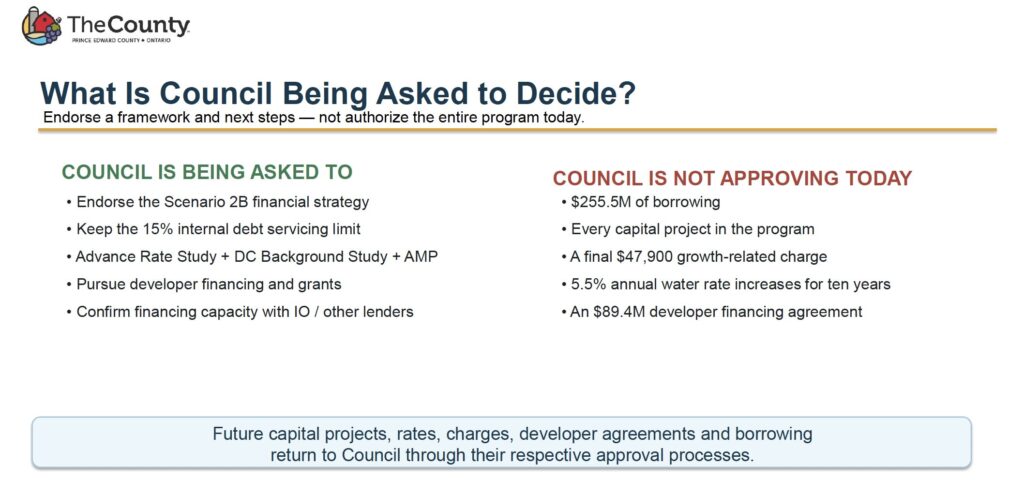
Despite a near-unanimous direction from council to municipal staff to research and prepare a financial strategy for water infrastructure expansion in June, the preliminary report, prepared by Director of Finance Arryn McNichol and Watson & Associates, failed 6-5 at the Committee of the Whole last week.
Councillors Braney, Engelsdorfer, Neiman, Maynard, Pennell, and Prinzen were opposed. Mayor Ferguson and councillors Hirsch, MacNaughton, Roberts, and St- Jean were in favour. Councillor Grosso was in favour but unable to vote remotely. Councillors Branderhorst and Harrison were absent.
The no-vote will stop all infrastructure and development planning unless it can be reversed at the September 8 meeting of council.
The financial strategy was a first step in formulating a long-term plan to finance the preferred solution to the County’s aging water infrastructure: a regional water treatment plant in Wellington to service residents in Wellington, Bloomfield and Picton, and three wastewater plants, one in each town.
The Director of Finance noted there is a strong case for one new plant: it’s more cost effective than building two, and both the Wellington and Picton WTPs are at capacity, while Picton’s 1928 plant will be at end of life in a decade.
Meanwhile, Picton Bay, the drinking water source for residents of both Picton and Bloomfield, is seriously compromised. As Don Caza, Director of Water and Wastewater Services, put it, “there are 300 identified threats to Picton’s drinking water in Picton Bay. It is one of the most threatened sources in Ontario. More stringent sampling is coming to Picton, at the province’s direction, and I’m not sure what it’s going to show. But we are going to be expected to be able to deal with what we need to do in response to that.
“The spill in Delhi almost shut our plant down again just this summer.”
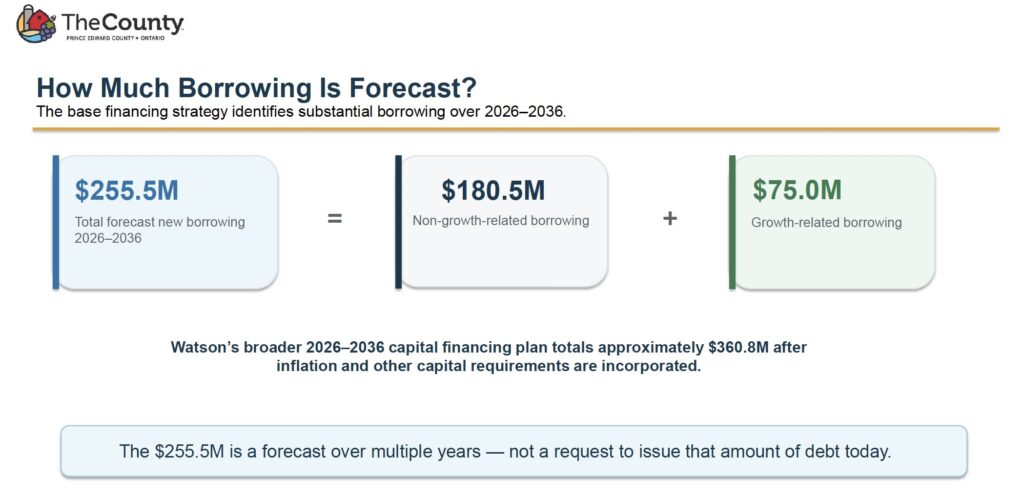
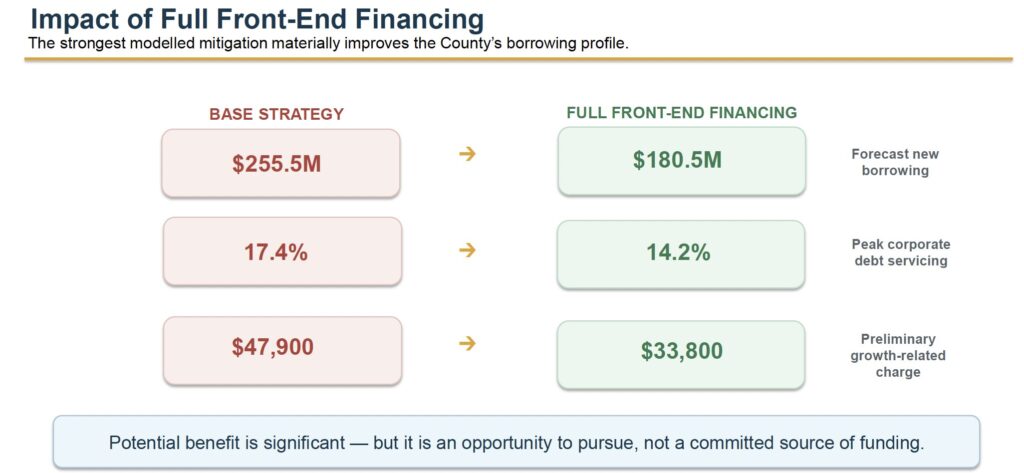
The failed financial strategy presented a conservative “Base Case” of $255.5 million in borrowing to cover the cost of new infrastructure. Perhaps it should have said “Worst Case,” as that number proved too much for councillors to swallow.
To finance all the borrowing, water and wastewater rates would increase about 4 percent a year to 2036. For a typical residential customer, the combined annual water and wastewater bill would increase from $1867 in 2026 to $2724 in 2036, or $857.
Development charges would increase to $48,000 for a single or semi-detached home, up from $26,000.
But the report also noted that everything would change for the better if the County’s cadre of developers could be convinced to pay upfront development charges (DCs). If developers pay the costs of the growth-related infrastructure they need in advance, they save the municipality $75 million in borrowing with all its interest charges. That drops DCs to $33,000 per house.
The $255.5 million borrowing figure includes $104 million to finance water infrastructure for the County’s existing population, while $103 million is growth related, meaning it’s eligible for upfront financing and/or must be paid for by DCs.
The County has already received $13.9 million in DCs from Kaitlin Corp for the waterworks expansion in Wellington. Agreements are yet to be negotiated with Base31’s developers, as well as Loyalist Homes, Port Picton Homes, and other developers who plan to build in the next five years.
The failure of the financial strategy means those agreements cannot be negotiated.
Councillors who were opposed equated approval of continued financial planning with approval of the capital projects themselves. As Councillor Braney put it, “This makes me extremely uncomfortable.
“This is just not the time for us to endorse or make anything close to an investment on this. We don’t have the means or capacity to do it. If this were my money, I would not make this investment at this point in time at all.”
Councillor Neiman concurred. “I’m not supporting this. I’m just not comfortable putting this kind of money for new plants and new infrastructure. I still don’t believe we’re going to have that kind of growth.”
In June, Council approved planning for a 1 percent growth rate, which would mean about 150 new homes every year and 9,000 residents over the 25-year planning horizon.
Watson & Associates’ Sean-Michael Steven noted, “we have a developer group here interested in proceeding with infrastructure. Their projects right now are stranded. There is no infrastructure in place to support new development beyond about 1000 homes in Picton and 3 in Wellington.”
All remaining servicing capacity in both Picton and Wellington is already allocated to Port Picton Homes, Base31, and Kaitlin Corp, which means new developers can’t get in.
“Having a roadmap in place is a good way to convince developers we are serious about putting in the infrastructure they need,” he stressed.
Councillor St-Jean noted, “no growth is not an option, or existing ratepayers will pay through the nose to replace all the infrastructure we have to replace. We do not have the money to pay for it.
“If we don’t approve this report, we aren’t even having conversations with developers.
“We will just lose everything. Let’s keep having conversations, getting more information, and planning for the future. If we don’t move forward we won’t get the affordable housing we need. We must allow staff to ask the questions they need to ask.”
Councillor Hirsch echoed the remarks. “The do-nothing option is not an option. If we do not proceed that increases rates even more than pursuing the regional plant option.”
He also noted, “the suggestion that no growth is happening is nonsensical. The Base is selling homes next month. Hundreds of units are about to start. It is not fiction, it is actually happening. Port Picton is building Cold Creek now. Kaitlin is looking for us to finish getting our pipes in in Wellington so they can build.
“If we don’t have a plan in place, the developers are not going to be interested in any kind of conversation. They need to know we have a plan for their projects. Without a roadmap there’s nothing to talk to them about and we fall back to the do nothing option.
“That’s just not viable.”
Without a long-term financial plan for required water infrastructure, the Water and Wastewater Rate Study and the Development Charges Background Study cannot proceed, while the 2027 Asset Management Plan update will have gaps. All need preliminary financing numbers and detailed information about the County’s failing water infrastructure. At the same time, notes Mr. Hirsch, water and wastewater treatment plant design contracts are also in jeopardy.
“And the $18.3 million we received from the province’s Housing Enabling Water Services Fund (HEWSF) is at risk, as would be, of course, any future grant opportunities.
“And certainly, the $20 million in federal development funds for a new Wellington wastewater plant will disappear if we fail to build a new plant.”
See it in the newspaper