Canada’s oldest weekly newspaper
© 2026 The Picton Gazette
Since 1830


 10° Clear
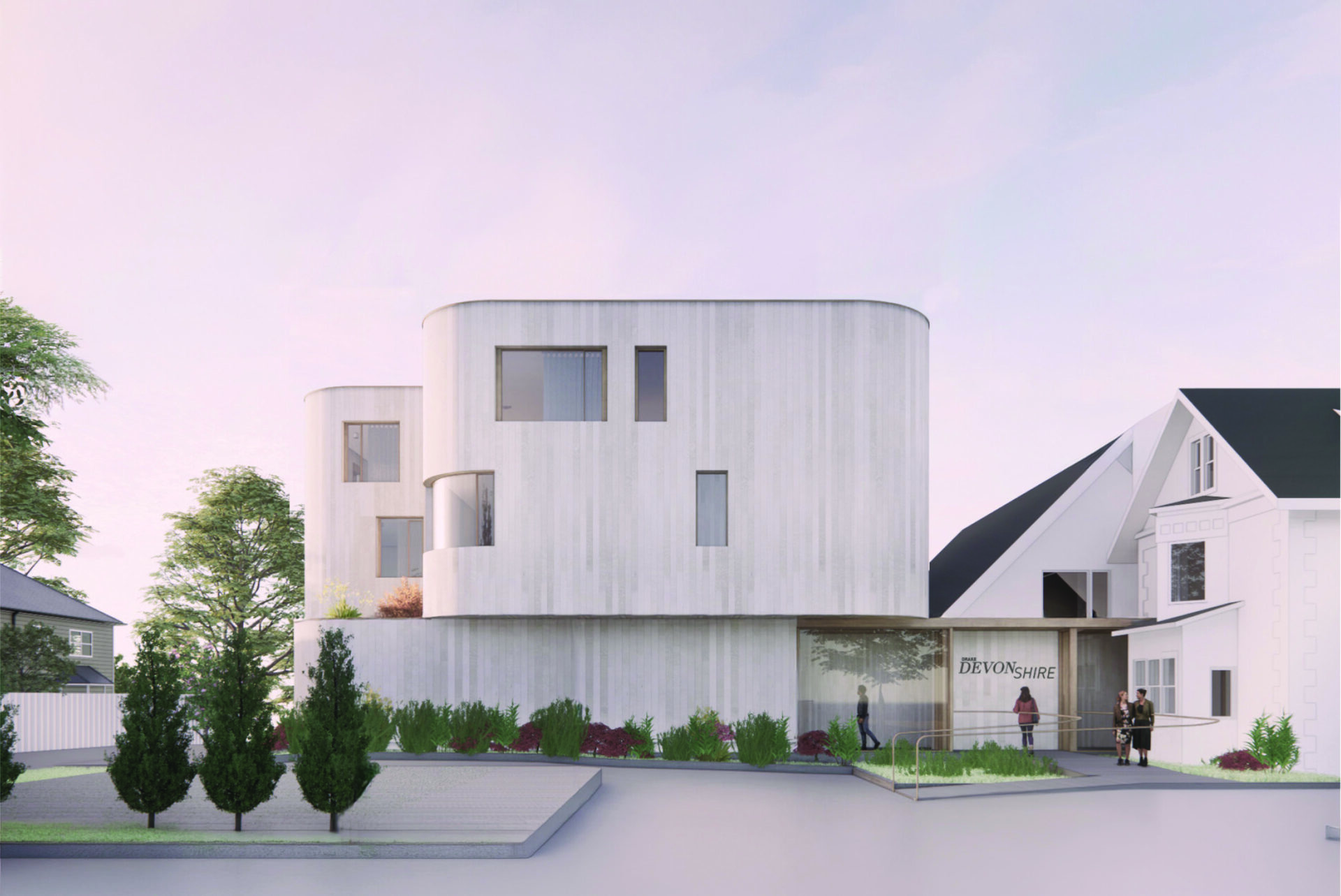 Rendering of the proposed Drake development, north view (Supplied Photo)
Earlier this month, the Heritage Committee moved to require the Drake’s development team to conduct a Heritage Impact Assessment for it’s proposed three-storey hotel addition.
Last night, however, Council overturned that motion. Instead, it voted 7-5 to allow the Drake to proceed with only staff consultation. Mayor Ferguson, Councillors Harrison, Branderhorst, Engelsdorfer, Maynard, Pennell, and St-Jean voted in favour of the referral.
Councillors Grosso, Hirsch, MacNaughton, Braney and Nieman were opposed. Councillors Prinzen and Roberts were absent.
The motion, brought by Mr. Engelsdorfer, directs staff “to continue to work collaboratively with [the Drake development team] towards an outcome that supports local business investment while honouring the character of the Wellington Heritage Conservation District Plan.”
The Drake Devonshire wants to expand its landmark heritage waterfront property with a contemporary three-storey addition.
Lead architect Philip Evans told the County’s Built and Cultural Heritage Committee that the plans add new guest accommodations and amenities while preserving the Drake’s base, the historic W.P. Niles House.
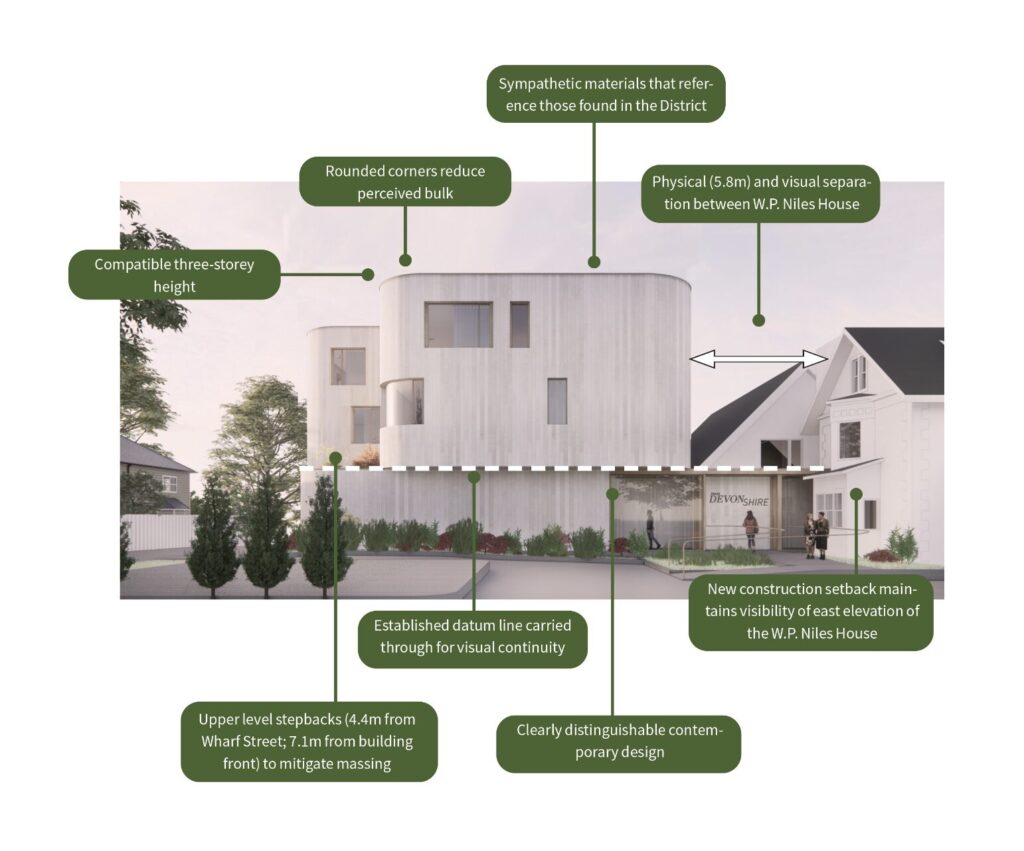
The new build features stepped-back upper floors, rounded corners and other contemporary design features. Mr. Evans said the plans respected the historic existing building by distinguishing new from old. He also stressed that they emerged over four years of planning and collaboration with County staff.
“This is a site with a history of adaptation,” he said, tracing the property’s progression from the Wellington Foundry to a private residence before becoming the Drake Devonshire.
But the Committee recommended Council defer the heritage permit application so a Heritage Impact Assessment (HIA) could be conducted.
Mr. Evans said the proposal was designed to preserve views of the historic Niles House while using contemporary architecture to clearly distinguish the addition from the heritage building, rather than attempting to replicate its design.
Not everyone agreed.
Richard Elliott, a concerned neighbour of the Drake, argued the addition is “clearly not secondary in scale, massing, and height.” He contended that it overwhelms Niles House rather than complementing it. Displaying a scaled rendering of the proposal, he challenged the argument that setbacks alone can preserve the site’s heritage character.
“It can’t be the case that, this massive addition, because it stops a few feet short of the north extent of the Niles House, anything’s permitted,” Mr. Elliott said.
He described an inconsistent application of the Wellington Heritage Conservation District Plan.
“Either the plan’s applied or it isn’t. If you want to amend it, amend it. There’s a process for it,” he said.
Another neighbour, Lourdes DaCosta, said the current proposal differs significantly from designs presented during the rezoning process. She said the earlier plans were more compatible with Wellington’s traditional architecture.
The new addition would replace what is currently a leafy, open view from her home with a “39-foot blank wall.”
“As a Wellington resident, it is disappointing and, frankly, insulting that the Drake expects its own commercial objectives to be well above the interests of its neighbours, the broader community, and everyone who adheres to the Wellington HCD Plan,” she said.
Dr. Diane Riley, speaking on behalf of the Wellington Community Association, questioned the architects’ comparisons between the proposed addition and Wellington’s historic Queen Anne homes.
“I live in one such Queen Anne, and I assure you there is no resemblance whatsoever between this design and my house,” she said.
Dr. Riley seconded descriptions of the addition as “too massive” for the village context, arguing its scale and contemporary design undermine Wellington’s heritage character.
Former Prince Edward County Heritage Advisory Committee member Liz Driver acknowledged the site’s history of adaptation, but argued the quality of that adaptation must also be considered.
Ms. Driver noted Wellington’s Heritage Conservation District Plan is less straightforward than Picton’s, and cautioned against relying solely on a technical interpretation of its policies. She suggested an independent Heritage Impact Assessment to determine whether the proposal respects the cultural heritage value of the Niles House and its surrounding context.
Those concerns resonated with committee members.
Committee member Edwin Rowse described the application as “the first major permit under the Wellington HCD,” adding that “the issues are complex and nuanced.”
“We do simply not have the information at the moment and the tools to make that decision,” he said.
The committee agreed to defer the application, and to require the applicant to complete a Heritage Impact Assessment under the Ontario Heritage Act.
The motion also recommends the County retain an independent heritage consultant, at the applicant’s expense, to do the Assessment, which must be completed in 90 days.
Councillor John Hirsch noted an independent assessment would help move the discussion beyond competing interpretations presented during the meeting.
“We’ve heard very good information this morning, but everybody has a self-interest,” Mr. Hirsch said. “The only way to resolve this is to indeed have an HIA provided.”
Staff will now return to Council August 25 with a recommendation about how to proceed.
See it in the newspaper