Canada’s oldest weekly newspaper
© 2026 The Picton Gazette
Since 1830


 24° Mostly Cloudy
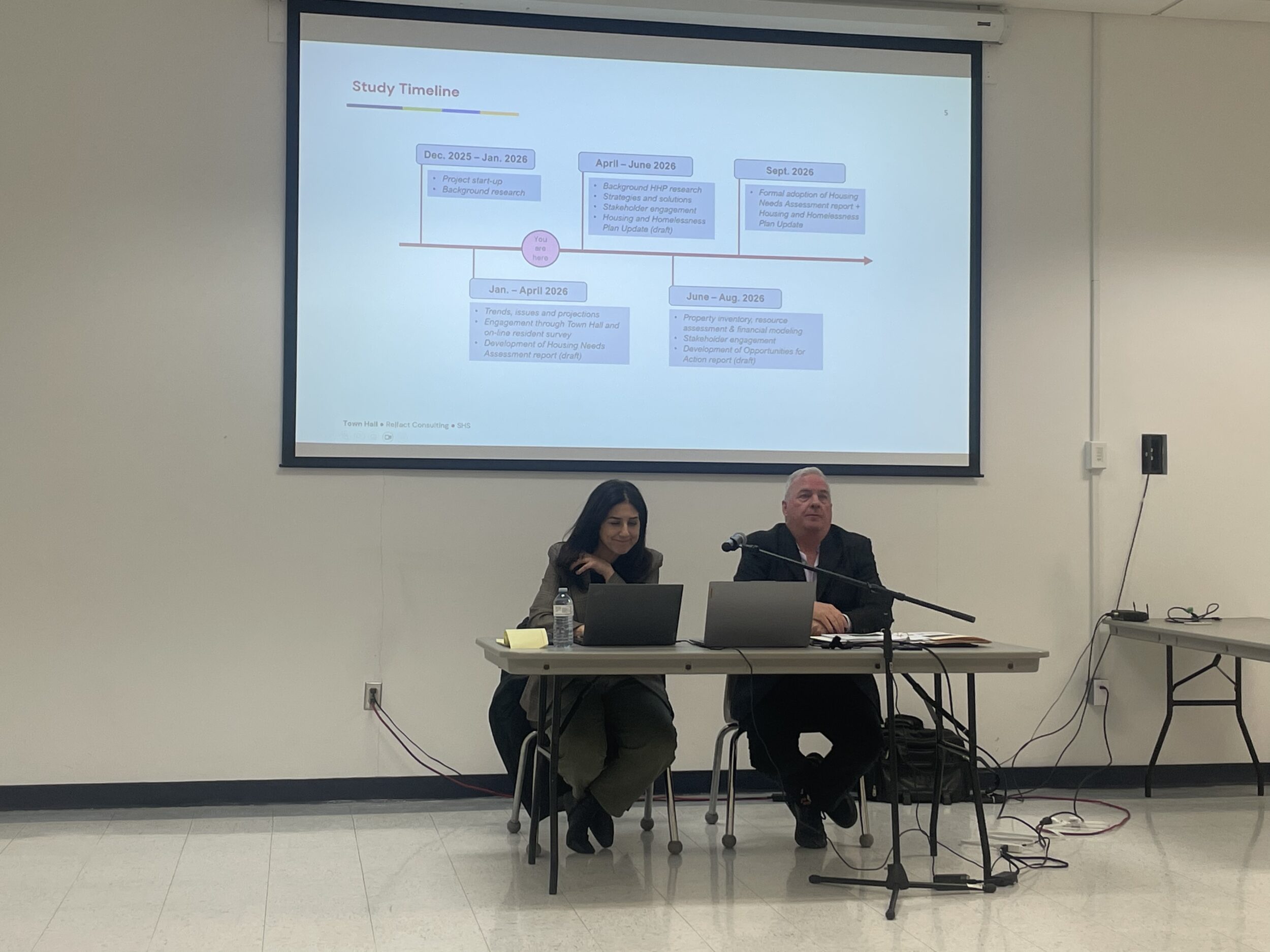 Bahar Shadpour and Ken Foulds (Photo: Eleanor Zichy / Gazette Staff)
The last Housing and Homelessness Plan for Prince Edward, Lennox and Addington Social Services (PELASS) was written just over ten years ago. Since then, the housing crisis has only deepened.
Scott Robertson, Manager of Social Services, noted that when the previous plan was written in 2014, “the part on homelessness was about a page and a half. Now, it could be a chapter.”
PELASS is hosting town hall discussions across the region to inform a new Housing and Homelessness plan. The first two took place in the County, in Wellington on March 30th and Picton March 31st. Project consultants Bahar Shadpour of SHS and Ken Foulds of Re/fact led a presentation and discussion, but the meeting was sparsely attended.
One of the biggest challenges, they noted, is the lack of affordable, or any, rental housing in the County. Purpose-built rentals make up less than 2 percent of housing construction in the County. The average is 17 percent in communities with a population above 10,000.
—Consultant Ken Foulds
This is not just a housing issue, it’s an economic development issue.
That leads to an over-reliance on the secondary rental market, meaning private homes. These units are both more expensive and less permanent. Homeowners often reclaim them for their own use.
Meanwhile rents skyrocketed between 2022 and 2025. As a result, the lowest 40 percent of renters can’t afford rent. An affordable rent is no more than 30 percent of household income.
Homeowners and buyers are also facing affordability issues. “Prices are out of reach for most households,” Ms. Shadpour said.
The average cost of a home in the County is in the $800,000 range, requiring household income of at least $200,000 a year. On top of that, “prices for home ownership are anticipated to rise in the coming years.”
“There’s also a mismatch between the housing available and the household size,” Ms. Shadpour continued. The demand is for more one- and two-bedroom apartments, but single-detached homes with three bedrooms or more are the dominant housing type.
Large houses will continue to be built, Mr. Foulds later noted, because they sell at a profit for developers.
Community input allows the consultants to compare lived experiences to their data sets, some of which, they acknowledged, may be dated. The last statistics Canada census was in 2021, while data from this year’s census won’t be available for several months.
Part of the discussion focused on how to prevent the homelessness crisis from worsening by keeping precarious renters in their homes.
Mr. Foulds said one of the biggest risks to housing stability is rent de-control, which allows a landlord to hike the rent between tenants. They even use legal loopholes to evict, such as planned renovations.
“Stabilization would be a tangible way to start,” he said. “Legal aid clinics have been working overtime with the number of ren-eviction applications.”
The housing crisis is detrimental to the local economy, with many workers across sectors unable to live in the County.
“This is not just a housing issue, it’s an economic development issue,” Mr. Foulds emphasized, adding the lack of ready workers could push the private sector to invest.
“I want to be cautious about our expectations,” Mr. Foulds said. “It’s a complex problem and it’s going to take some steps.”
Mr. Foulds also remarked that while a regional Housing and Homelessness Plan is required by the Housing Services Act, it does not come with provincial funding.
Upper levels of government have made a “generational investment” in housing over the past five years, but, “the challenge is unlocking that money.” Rural communities building at a small scale tend to get overlooked.
Town halls will continue throughout April across the region. In May the consultants will move on to stakeholder discussions.
A draft plan will be reviewed by PELASS and the Ministry of Municipal Affairs and Housing by June.
The final version comes to Council in September.
See it in the newspaper