Canada’s oldest weekly newspaper
© 2026 The Picton Gazette
Since 1830


 24° Mostly Cloudy
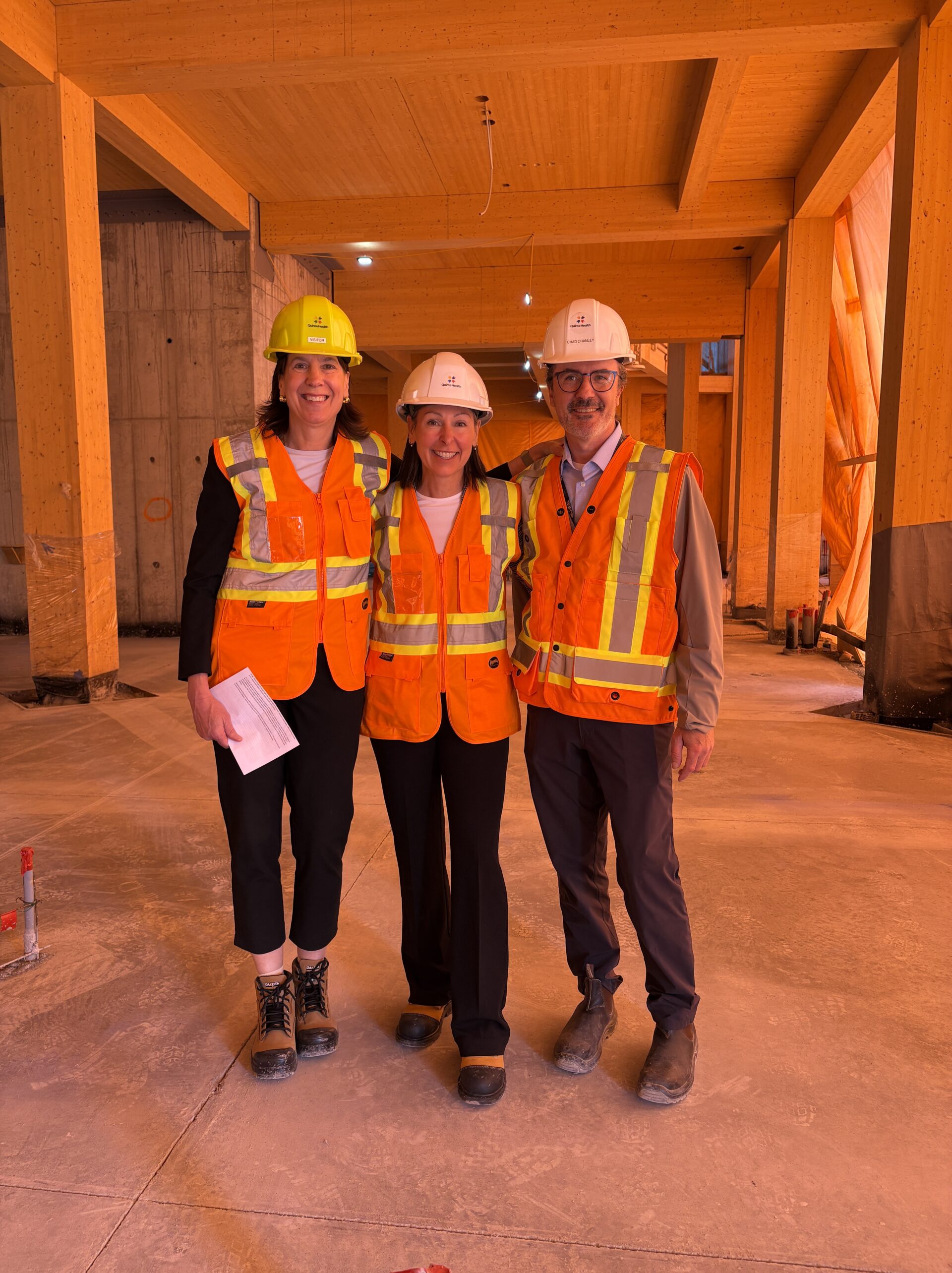 Quinte Health President Stacey Daub, Hospital Foundation Executive Director Shannon Coull, and Quinte Health’s Director of Facilities Chad Cranley show off a just-poured cement floor, marvel at what will be massive, double-height glass walls, and point out the gorgeous timber ceiling in Picton’s new hospital.
(Karen Valihora/Gazette Staff)
Quinte Health President Stacey Daub, Hospital Foundation Executive Director Shannon Coull, and Quinte Health’s Director of Facilities Chad Cranley show off a just-poured cement floor, marvel at what will be massive, double-height glass walls, and point out the gorgeous timber ceiling in Picton’s new hospital.
(Karen Valihora/Gazette Staff)
The new Prince Edward County Memorial Hospital will be finished by the end of next year, and receiving patients in early 2028.
About 90 percent of the new building, or 97,000 square feet of the timber frame structure, is now standing. Meanwhile, in a spectacularly successful community fundraising campaign, the Memorial Hospital Foundation has raised $28 of the $30 million County contribution to the new build.
As a glowing Shannon Coull puts it, “every single person in our community is going to be able to say they’ve been involved in the success of this campaign and each one of our community members can have ownership of our hospital.” Ms. Coull is the Executive Director of the PECM Hospital Foundation, its fundraising wing.
While it will be some time before the public can walk through the doors, Quinte Health hosted a virtual tour of the new build last month. Over 70 viewers joined in. It has also been leading small groups of stakeholders through the new structure.
“This winter was absolutely unprecedented and really challenging from a construction standpoint,” said Stacey Daub, President and CEO of Quinte Health.
Harsh weather, a labour dispute, and the challenge of sequencing the complex structure pushed completion to fall 2027.
The labour dispute was a strike action taken by LiUNA local 183 in 2025, employees of a construction subcontractor.
“These are not unusual delays,” Ms. Daub said. “We are not willing to compromise quality simply to maintain an original timeline estimate. What matters most is delivering a high-quality hospital that will serve this community well for generations.”
The County’s new hospital will be the first unencapsulated timber-frame hospital in North America. Ms. Daub said she hopes the milestone will show other rural communities that they can follow suit. Jeff Mosher of HDR Architecture said the timber frame design reflects the County’s built heritage.
“There’s a bit of a motif here of the barn,” Mr. Mosher said. “If Niagara is the Country Club, Prince Edward County is the barn dance.” The first documented structure in the County was a mass timber cottage.
The hospital’s timber comes from a sustainable family-owned woodlot in Northern Quebec.
Timber framing boasts energy efficiency, a lower carbon footprint, and elegance.
Mr. Mosher notes that the “beauty, warmth, and tactility of the timber,” creates a “biophilic” environment that promotes a feeling of connection with nature. This in turn can have positive effects on the well-being of patients.
He also debunked concerns around infection posed by a timber framed structure.
He noted that wood can’t grow microbes as long as it remains under a 19 percent moisture level. Like a wood cutting board, it wicks moisture away. The wood will be sealed to improve its washability.
To mitigate the risk of fire, the hospital is composed of three distinct buildings, with doubled walls at meeting points, and each with its own entrances and exits.
Additional fire protection was secured by oversizing materials, which creates a longer burn rate and maintains the structural integrity of the building in the event of evacuation.
Beyond timber framing, other sustainable features include solar panels, green roofs, EV parking, advanced heat recovery, and operable windows.
“It is a net-zero ready hospital,” Mr. Mosher said.
Geothermal piping will produce 90 percent of the building’s heating and 50 percent of its cooling.
Quinte Health’s Director of Redevelopment and Facilities, Chad Cranley, walked the group through the layout. The first floor will house the emergency department, ambulatory care, a 23-bed inpatient unit, support services, and imaging, including a CT scanner, x-ray, ultrasound, mammography, and cardio-diagnostics.
The second floor features a dialysis unit, a multi-faith space, and access to the green roof.
The old hospital, which sits next door, will be demolished to make way for parking.
“When I stand inside the walls of the new hospital, I think the word that comes to mind is wonder,” said Ms. Daub.
But the structure is only half the story. Quinte Health is also ensuring a healthcare team is in place for the opening of the hospital.
“People often say, ‘we’re going to have a new hospital but will we actually have enough doctors to work at that hospital?’” said Ms. Daub. “It’s a common question — and with Barinder (Gill) and others at the Family Health Team we’re seeing more physicians coming to our community.
“This hospital itself is a draw. A big one.”
“Innovation and sustainability are critical aspects of the build of our new hospital,” says Quinte Health President Stacey Daub.
The precedent-setting mass-timber design is energy efficient, durable, environmentally and socially conscious, said Jason-Emery Groen, Design Director at HDR Architecture and the hospital’s lead architect.
Concrete and steel, common building materials for hospitals, “take an incredible amount of energy to produce,” Mr. Groen noted. In comparison, HDR Architecture estimates that using wood as the primary material will save nine million kilograms of embodied carbon dioxide. Solar panels and green roofs enhance those efficiencies.
A geothermal energy system “will provide a significant amount more energy than it consumes,” said Mr. Groen. “So, literally, magic.”
The building will support patients, their families, and staff. “We want it to naturally promote health,” he said.
Mass timber has “biophilic” qualities: it creates a connection to the natural environment, making people feel more at ease.
Outdoor seating will be surrounded by native plant landscaping. The building also features entire walls of glass, and oversize windows that actually open.
Ms. Daub noted that healthcare workers get stretched over the winters by a “quademic” of Influenza, RSV, Covid, and Norovirus. The design of the hospital extends sustainability to sustaining a healthy workforce.
An outdoor courtyard just for staff will offer respite during long shifts.
“We really want to ensure the building performs and allows for staff to connect to the patients, to the families, and to everyone that is welcome here in the facility,” said Mr. Groen.
See it in the newspaper