Canada’s oldest weekly newspaper
© 2026 The Picton Gazette
Since 1830


 24° Mostly Cloudy
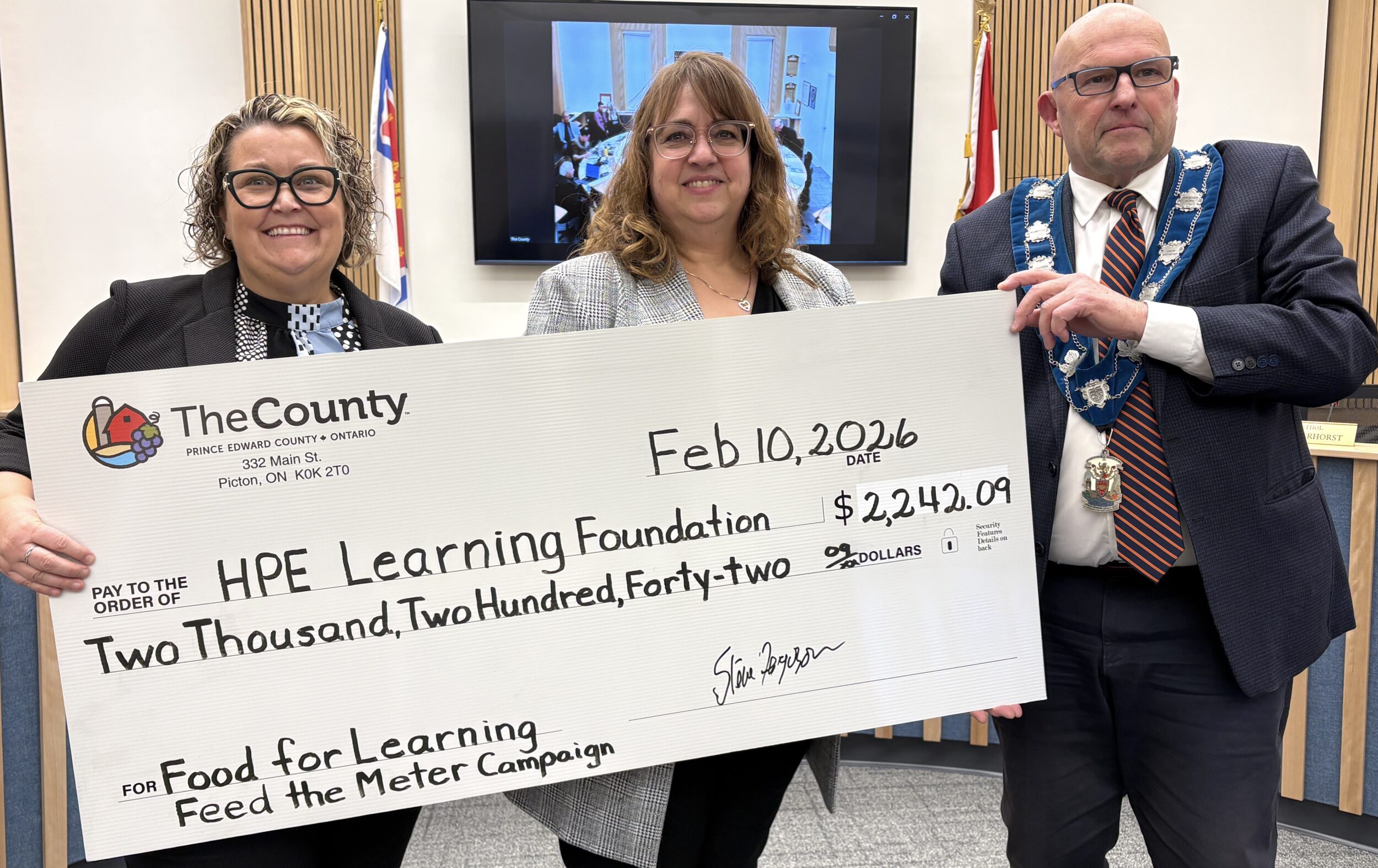 From left: Jenn Barrett and Kellie Brace of the Hastings Prince Edward Learning Foundation accept the 2025-26 Feed the Meter donation from Mayor Steve Ferguson. (Karen Valihora/Gazette Staff)
The numbers are staggering — and growing.
Hastings Prince Edward Learning Foundation Executive Director Kellie Brace and Resource Development Coordinator Jenn Barrett presented their Food for Learning student nutrition program at the February 10 Council meeting.
Last year, over 1.5 million snacks and meals were distributed to children in the Quinte area. Thousands of supporters contributed over 24,000 volunteer hours to make the program a reality. Food for Learning operates 134 programs at 70 sites across Hastings-Prince Edward elementary and secondary schools.
Early estimates for the current school year indicate program uptake has increased 42 percent compared to this time last year.
Ms. Brace explained that new supports, federal initiatives and enhanced partnerships have made program delivery more widespread. Locally, PECI was able to launch a Free Bagged Lunch program for its elementary panel through pilot program funding.
In Prince Edward County, Food for Learning provided over 186,000 meals and snacks. On average, 830 children use programming daily. All County elementary schools and PECI offer either breakfast, lunch or a snack — and sometimes all three.
Ms. Barrett noted local children are eating healthily. Fresh fruit and vegetable consumption increased by 289 percent. She added that local partnerships continue to be vital and pointed to the County Food Collective and the County Food Hub at Sophiasburgh Central. Thanks to combined efforts, weekly lunch programs organized at the Hub have allowed three elementary schools to offer weekly lunch programs.
Mayor Steve Ferguson thanked the Learning Foundation for the work they do addressing youth food insecurity and presented Ms. Brace and Ms. Barrett with a cheque for $2,242, the proceeds from this year’s Feed the Meter program.
Council is buying some time to use provincial funding for the County Road 49 rehabilitation project.
The County now has to the end of 2028 to use a $20 million award from Ontario’s Housing-Enabling Core Servicing fund. Staff applied in August to Ontario’s Ministry of Infrastructure to extend the project completion deadline. Council has now approved an amendment to the original Transfer Payment Agreement, as agreed to by the province.
The provincial funding only covers about half of the cost of rehabilitating CR 49. Council reallocated $7 million originally earmarked for Phase 3 of the Main Street reconstruction project to 49. The municipality is counting on funding from the federal government to complete the full rehabilitation of the concrete, Centennial-era road.
While the project is essentially tender-ready, the lack of full funding, the large scope of work, and the specialized equipment required, meant the municipality was unlikely to meet the original project completion deadline of March 31, 2028.
If federal dollars for the 49 project never materialize, the provincial funds could still be made available — but any deviation from the original plan will require a change of scope application and provincial approval.
Council passed a resolution of support to designate Barker Street from Bowery Street east to Paul Street for two-way traffic.
As part of the resolution, staff will conduct an emergency services consultation and give public notice to area residents.
Staff will return to Council to detail findings and implementation feasibility.
Councillor St-Jean said requests to make Barker a two-way street have been made by local residents since the closure of the Queen Elizabeth school. Upon investigation, the councillor discovered the street was made a one-way thoroughfare without support of a bylaw, meaning staff and Council may be able to fast-track the process of opening it to two-way traffic.
See it in the newspaper